
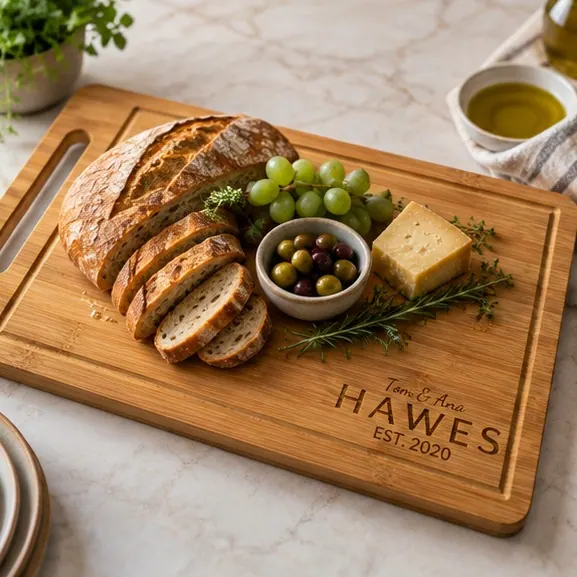
Classic Last Name
First names, last name and an optional EST year in the most versatile layout on the site.
$32.99–$39.99
Home › Guides › How Much to Spend on a Wedding Gift
10 min readSensible amounts by relationship, why the cover your plate rule is folklore, and how travel, attending as a couple and the registry change the number.
For most wedding guests, $75 to $150 is the right range, and for a coworker or a friend invited because the circle was wide, $50 is entirely respectable. The number moves with one thing that always matters, which is how close you are to the couple, and two that sometimes do, which are whether you are attending as a household and how much you already spent to be in the room.
Everything else repeated as a rule is convention, including the bands below. They are judgment about what reads as generous without being conspicuous, and they are not measured data: no survey averages appear anywhere in this guide because none are sourced here, and borrowing a statistic you cannot check is how bad gift advice spreads.

| Relationship | Convention band | Why it sits there |
|---|---|---|
| Coworker, or someone you mostly know professionally | $50 to $75 | Enough to be a real gift, not enough to imply a closeness that is not there |
| Friend of the wider circle, a partner's friend, a cousin you rarely see | $75 to $100 | The default for most invitations most people receive |
| Close friend, the group you actually see | $100 to $150 | The band where a gift starts being remembered as yours |
| Sibling, parent, child, the people setting the household up | $150 and up | Often less about the figure than about buying one substantial thing |
| Wedding party member | $100 to $150 | Already down several hundred on attire, travel and the shower before the gift |
| Plus one who has never met the couple | Folded into one gift from both of you | Two names on one card, one gift, no separate spend |
Read the bands as ranges, not thresholds: the bottom of one is not stingy and the top is not required.
A named board at $32.99 in bamboo or $39.99 in acacia, plus $8.00 shipping, lands at $40.99 or $47.99 delivered. That is a complete gift in the first two bands, where what is being bought is a specific object with their surname on it rather than a quantity of money. In the family band it wants to be part of a larger gift rather than the whole of it, and pretending otherwise would be dishonest. The ranked list of personalized options by budget is the fuller version of that argument.
The rule says your gift should at least match what the couple paid per head for your dinner. It does not survive one question, which is who decided that figure.
The couple did, when they chose the venue and the catering. If cover your plate were an obligation, a couple who booked a high-priced ballroom would effectively be billing their guests for a choice the guests had no part in, and a couple who married in a backyard with a taco cart would have released theirs from any duty at all. Both conclusions are absurd, which tells you the premise is wrong. Hosting is a host's expense. Guests are not underwriters.
There is a practical objection too. You cannot know the number. You would be reverse-engineering it from the flowers, the bar and the main course, and you would be wrong in the direction of spending more, which is why the rule gets repeated so cheerfully by people selling things. It also produces exactly the wrong behavior: it tells guests at expensive weddings to give more and guests at modest ones to give less, when the household that needs help getting set up is frequently the one that could not afford the ballroom.
Use the formality of the wedding as a loose signal about the circle you are in, if you want. Do not use it as arithmetic.
No. It moves the number to roughly one and a half times what one person would give, not two times.
A wedding gift is one gift from one household, and a household of two is not two guests who happen to share an address. If $100 is right for you alone, $150 from the two of you is generous and $200 is not required. A plus one who has never met the couple changes nothing: the gift is yours, the card carries both names, and nobody is keeping a ledger.
A guest who bought flights, booked three nights and took days off has already spent more on being present than most guests spend on the gift. Give at the bottom of your band, or below it, and do not apologize. A couple who invites people to another city has chosen to convert part of their guests' gift budget into airfare, and most couples know it. Attendance is the expensive part, and the gift is the gesture.
That makes a destination wedding one of the best cases for a small specific object rather than a larger generic one. A $32.99 to $39.99 board with their surname and the year, ordered to arrive at their home rather than carried in a suitcase, is honest about what the trip cost you and still unmistakably chosen. No prices and no packing slip go in the parcel, so what arrives is the object and the card, not a receipt.
No. A registry is a list of things the couple want, at whatever those things happen to cost. It is not a menu of acceptable price points, and the cheapest item on it is on it because they want it.
Buying the $40 registry item is buying something the couple asked for by name, which is the entire function of a registry. Where a registry lists one expensive item with a group contribution option, contribute your band and stop there. If you are weighing a registry item against something with their name on it, the two do different jobs, and the case for and against an engraved board sets out where the personalized option is the wrong call as well as the right one.
Cash is always the correct size and almost never remembered. An object is remembered and can be wrong. Both are true at once, which is why the sensible answer is usually a split.
Where a community or a family has a cash convention, follow it. That convention is older and stronger than any advice here, and giving an object into a cash culture reads as a small refusal.
Otherwise the arrangement that works at most bands is a named object plus the balance in the card. At the $100 band, a $39.99 acacia board and $50 in the card does two jobs: the money goes toward the deposit or the sofa, and the object goes on the counter with their surname on it. The object is what makes the gift identifiable years later; the cash is what makes it useful next month.
Give less, and give it well. That is the whole answer, and it is not a consolation prize.
The honest lower bound is whatever you can give without resentment. A gift that quietly hurt to buy is not a better gift, and no couple worth attending would want one. What distinguishes gifts at the bottom of the range is specificity: a $40 object carrying their surname and the year cannot be filed under things we own, and a $150 generic serving set can. That is reasoning about how people categorize objects rather than a measured result, and it is why a modest personalized gift holds up against a larger anonymous one.
Two things cost nothing: a card referencing something only you could reference, and being useful on the day. If you are in the wedding party and already stretched, the bridesmaid gift guide covers the same arithmetic from inside the party. And if you gave at an engagement party or a shower, that counts. Engagement gifts and shower gifts are separate occasions, but your band describes the total across all three, not the wedding day alone.
It is widely repeated and it is not an obligation. The per-head cost of a wedding is set by the couple when they choose the venue and the catering, so treating it as a guest's minimum means billing guests for a decision they had no part in. Use the formality of the event as a loose signal about the circle you are in, and use your relationship to the couple for the actual number.
About one and a half times what one of you would give alone, not double. A wedding gift is one gift from one household, so if $100 would be right for you on your own, $150 from the two of you is generous. Two names go on one card and nobody is auditing the arithmetic.
Yes, and it is expected. A guest who paid for flights, hotel nights and time off has already spent more on attending than most guests spend on the gift, so the bottom of your band or below it is appropriate. A small specific gift shipped to the couple's home, rather than something carried in a suitcase, is the best shape for it.
No. A registry lists things the couple want at whatever prices those things cost, not a set of acceptable spending levels, and the least expensive item on it is there because they asked for it. Buying that item is buying exactly what was requested, which is what a registry is for.
Cash is always the right size and rarely remembered; an object is remembered and can miss. Where a family or community has a cash convention, follow it. Otherwise a split works best: a named, specific object plus the balance of your band in the card.
Give what you can without resentment, and make it specific rather than large. A modest object carrying the couple's surname and the year, at around $32.99 to $39.99, plus a card that references something only you could reference, lands better than a stretched generic purchase. Showing up and being useful is also a real contribution.
Usually yes. Attire, travel, the shower and the party have often cost several hundred dollars before the gift is considered, and that spending is visible to the couple. Something in the $100 to $150 band, or below it if the party costs ran high, is entirely appropriate.
All three layouts take a surname and a year, in bamboo at $32.99 or acacia at $39.99, with a live preview of your own text before you order, and the bamboo last name board is the straightforward version. Before committing the wording, what to engrave on a wedding board covers the surname and year decisions including the awkward cases. Allow about nine days from checkout: three working days in production and about six in transit.
First names, last name and an optional EST year in the most versatile layout on the site.
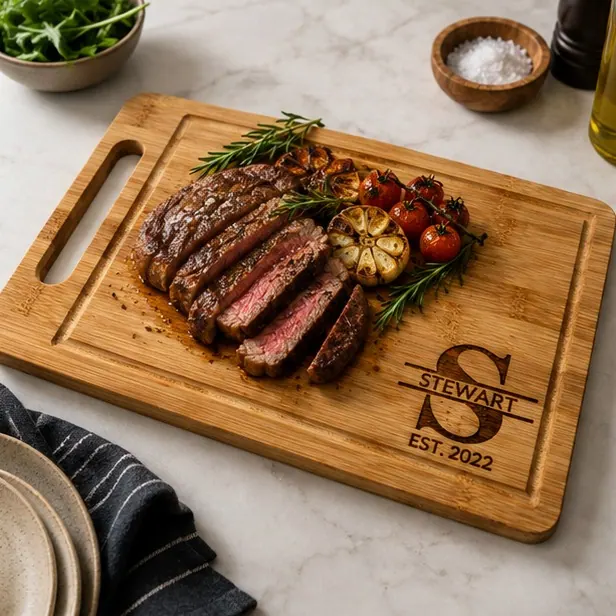
A timeless split layout with your initial, last name and optional EST year.
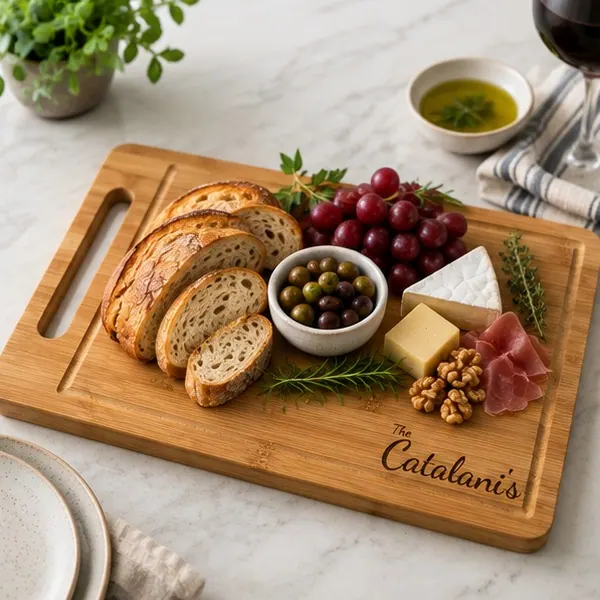
Soft script styling with an heirloom feel, especially strong for wedding gifting.
A butcher block is a thick end-grain or edge-grain surface that mostly stays put. A cutting board is a tool yo
Personalized means something gets made after you order, so it is not a same-day category. Here is the real tim
What to give parents who say they want nothing, how to split one gift between siblings, and what to engrave wh