
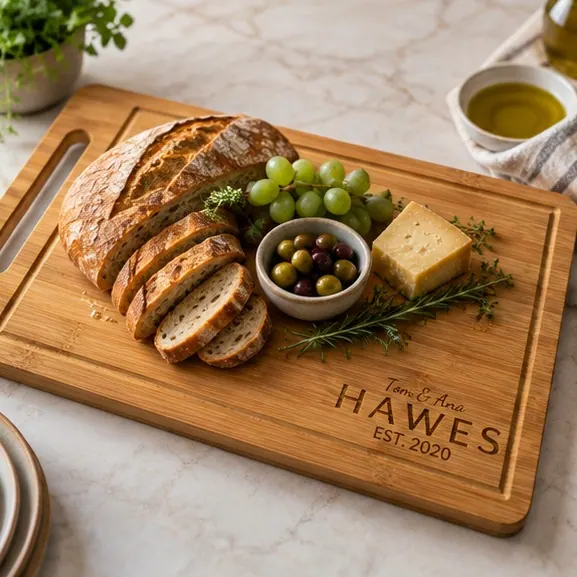
Classic Last Name
First names, last name and an optional EST year in the most versatile layout on the site.
$32.99–$39.99
Home › Guides › Cutting Board vs. Butcher Block: What Actually Separates Them
10 min readA butcher block is a thick end-grain or edge-grain surface that mostly stays put. A cutting board is a tool you lift. Here is which one a kitchen needs.
A butcher block is a thick slab, usually end grain or heavy edge grain, that lives in one spot and gets worked on. A cutting board is a thinner piece you pick up, carry to the sink, wash and put away. Everything else follows from that one difference: mass, price, maintenance, how the surface treats a knife, and which of the two your kitchen actually needs.
The obvious thing first. We do not sell butcher block. We sell a 12 inch board, and this page exists because most answers to this comparison are written by someone selling one side of it.
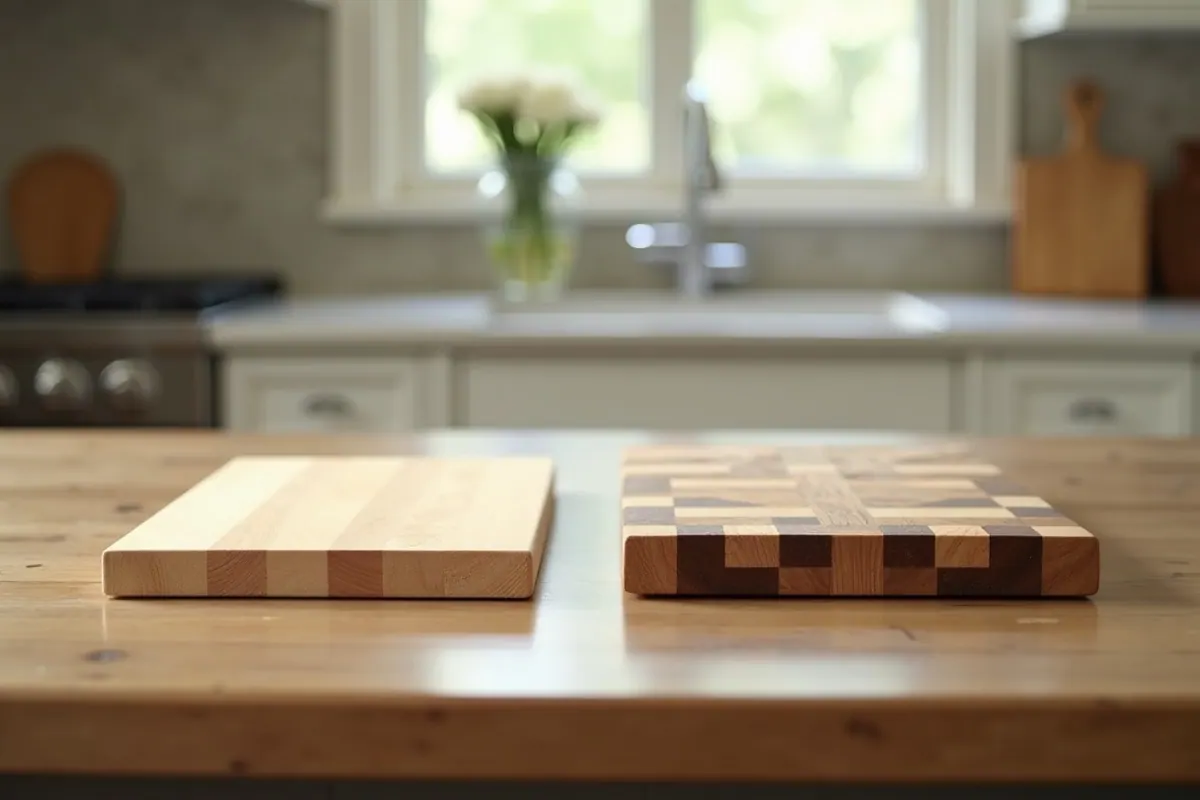
The term describes a construction method, not a wood and not a price bracket. Strips or blocks of hardwood are glued into a single slab thick enough to be structural. It is the same technique that makes a butcher block countertop, an island top or a freestanding chopping block. Two things define it in practice.
Thickness. A butcher block is measured in inches, not fractions of one, because the whole point is a surface that does not flex, does not move, and has enough material in it to be resurfaced many times over its life.
Position. A true block stays where it is. Some are built into a counter or stand on their own legs. Some are movable in the sense that two people can move them, which is not the same as movable. You bring food to a block. You bring a board to food.
Anything you can lift one-handed and carry to the sink is a cutting board, whatever the product title calls it. A lot of listings use "butcher block" as a style word for anything made of glued hardwood strips, and that is where most of the confusion in this comparison comes from.
| Butcher block | Cutting board | |
|---|---|---|
| Construction | End grain, or heavy edge grain, glued into a thick slab | Any grain, thin enough to stay light |
| Thickness | Inches. Built to be structural | Usually well under an inch |
| Weight | Heavy enough that moving it is a decision | Light enough to carry with one hand |
| Where it lives | On the counter or built in, permanently | In a cupboard, a rack or on edge by the sink |
| Washing | In place, with a scraper, cloth and hot soapy water | Carried to the sink, both faces washed, stood on edge to dry |
| Knife edge | End grain is the kindest surface in a kitchen | Kind, well ahead of glass, stone or a metal tray |
| Visible cut marks | End grain closes over and hides them best | Cuts stay more visible on a face-grain surface |
| Resurfacing | Sanded or planed in place, and there is a lot of material to take from | Sanded with 220-grit, and there is less to give |
| Oiling | The same routine over a far larger surface, so it takes longer | About four minutes a month |
| Best at | Sustained volume: breaking down meat, prepping for a crowd | Everyday work, serving, carrying, gifting |
| Serving and table use | Rarely. It is equipment and it stays put | Yes, which is most of why people buy a nice one |
| Engraving as a gift | Impractical to give, expensive to ship | The reason personalized boards exist |
| Price | We do not sell them and will not quote a figure for them | $32.99 bamboo, $39.99 acacia here, plus $8.00 shipping |
This is the only technical argument in the comparison that changes anything. Picture a bundle of drinking straws glued together: that is roughly what wood is, long fibers running the length of the tree.
| Grain | What you are cutting into | Effect on the edge | Cut marks |
|---|---|---|---|
| End grain | The cut ends of the fibers, standing up like the straw openings | The edge slips between fibers rather than across them, which is the gentlest of the three | Least visible. The fibers close back over |
| Edge grain | The narrow side of each plank, fibers running sideways | Kind to an edge, and the most common construction in good boards | Visible but modest |
| Face grain | The broad flat face of the plank | Still far kinder than any hard surface, and the least forgiving of the three | Most visible, since cuts stay open across the face |
End grain is the property people are really buying when they buy a block, and it is also why blocks are thick: to present end grain you have to stand the pieces on end, and a slab of standing fibers needs depth to hold together.
What it does not mean is that a knife is being damaged by a normal wooden board. The surfaces that genuinely wreck an edge are glass, stone, ceramic and steel trays, and the gap between those and any wooden board is enormous next to the gap between end grain and face grain. Wood versus plastic covers the surfaces that matter and the ones that do not.
Strip out the vocabulary and three numbers decide this.
Thickness. A block has enough material to be planed flat repeatedly across decades of heavy use. A board has enough to be sanded with 220-grit several times, which for a home kitchen is plenty. Our two are 0.5in in bamboo and 0.6in in acacia, and both are boards by every definition on this page.
Weight. This is the honest deal breaker for most households. Weight is a genuine advantage under a knife, because a heavy surface does not skate, and it is also the reason a block does not go to the sink, the table or a cupboard. Ours are recorded at 15oz bare, which is the trade in the other direction: it wants a damp cloth under it if the counter is slick, and it goes anywhere you want it.
Price. We are not going to quote prices for products we do not stock, because a competitor's pricing is not a fact this shop can stand behind. Look at two listings for a thick end-grain block and two for a good lift-and-carry board, and the gap explains itself in a minute. Ours are $32.99 in bamboo and $39.99 in acacia, with shipping at $8.00 for the first board and $4.00 for each additional one on the same consignment.
The routine is the same in kind and much bigger in scale.
A board gets washed in hot soapy water on both faces and the edges, towel dried, stood on edge, and oiled with food-grade mineral oil every month or two. That is roughly four minutes a month, and how to care for a wooden cutting board covers the whole routine including reviving a neglected one.
A block cannot be handled that way. It is washed in place, which means a bench scraper, a cloth rather than a sink, and care not to leave standing water on a surface that cannot be tipped up to drain. It cannot be stood on edge, so it dries in whatever airflow the kitchen gives it, and oiling covers a much larger area. None of that is an argument against a block. It is an argument for knowing what you are signing up for: a block rewards people who use it constantly and punishes people who use it twice a month.
Raw meat is the one area where nothing changes between the two. Both are wood, so the guidance is the same: keep raw meat, poultry and fish separate from ready-to-eat food, wash thoroughly between jobs with hot soapy water, and resurface or replace any surface whose cuts have got too deep to clean out. A trenched surface is the real problem in either format.
Stop at the first one that describes you.
A butcher block is a thick slab of glued hardwood, usually presenting end grain, heavy enough that it stays in one place on a counter or stands on its own legs. A cutting board is thin and light enough to pick up, carry to the sink, wash on both faces and put away. Thickness and mobility are the dividing lines, not the wood or the price.
End grain, because the blade passes between the standing fibers rather than across them, and the fibers close back afterward. Edge grain is close behind and is the most common construction in good boards. Both are far kinder to an edge than glass, stone, ceramic or a metal tray, and that gap is much larger than the gap between the two wood options.
Only if you are regularly doing work the board cannot take: breaking down whole birds or joints, heavy cleaver work, or prep volume for a crowd on a routine basis. For everyday cooking a board of the right size does the same jobs and does several the block cannot, including going to the sink and going on the table. Most home kitchens do not have a volume problem to solve.
Yes, mainly because of scale and because it cannot go to the sink. It is scraped and wiped in place rather than washed under a tap, it cannot be stood on edge to drain and dry, and oiling covers a much larger surface so it takes proportionally longer. Resurfacing is a sanding job done in the kitchen rather than a quick pass with 220-grit over the sink.
It generally is not, because it does not move. Serving assumes the surface travels to a table with food on it, and a block is heavy enough that it stays where it was installed. That is the job a presentable lift-and-carry board covers and a block does not, which is why households that own a block often still own a nice board.
Physically a laser can mark any wood face, but it makes little sense as a gift: a block is heavy to ship, costly, and a large permanent object to put in someone else's kitchen without asking. Engraving suits an object that gets seen and handled, which is the board. That is the whole reason personalized boards exist as a category and personalized blocks essentially do not.
Ours is a gift and serving board, and it is worth being exact about that rather than borrowing the word butcher block for marketing. It is 12in x 7.8in x 0.5in in bamboo with an integrated handle and a groove channeled around the face, or 12in x 8in x 0.6in in acacia with a flat unbroken face, both recorded at 15oz bare. It is built to be picked up, used, washed, and put on a table with a family name burned into it.
If what you want is a heavy end-grain block for daily butchery, buy one. If a board is the right object, the shop previews all three layouts with your own names on them, and the acacia board at $39.99 is the one to look at first if you like visible grain. Bamboo versus acacia covers how the two take an engraving differently, and a $6.00 gift box with a printed card of up to 200 characters is available on either.
First names, last name and an optional EST year in the most versatile layout on the site.
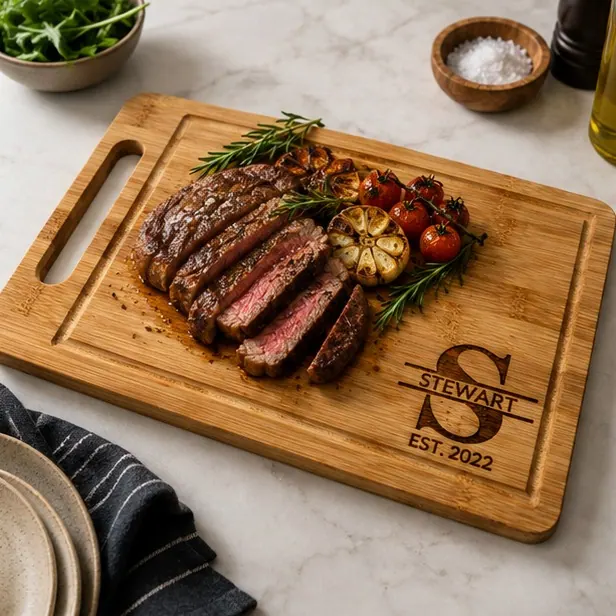
A timeless split layout with your initial, last name and optional EST year.
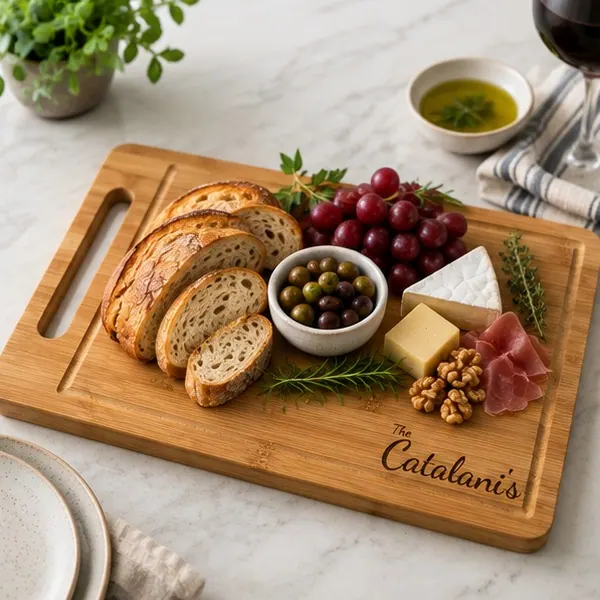
Soft script styling with an heirloom feel, especially strong for wedding gifting.
Personalized means something gets made after you order, so it is not a same-day category. Here is the real tim
What to give parents who say they want nothing, how to split one gift between siblings, and what to engrave wh
Birthdays have no shared event to mark, which is what makes them hard. What to engrave, why the birth year is