
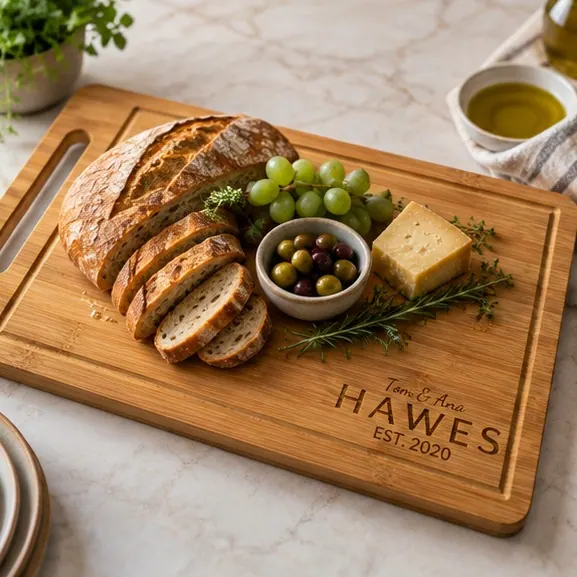
Classic Last Name
First names, last name and an optional EST year in the most versatile layout on the site.
$32.99–$39.99
Home › Guides › Bamboo vs. Acacia Cutting Boards: Which Makes the Better Gift?
7 min readBamboo runs pale, thin and $7.00 cheaper. Acacia runs darker, thicker and full of grain. How the two woods differ in the kitchen and under a laser.
Every board on this site comes in two woods, and the choice stalls a lot of orders. The honest answer is that neither is better. They are different materials that suit different kitchens, and once you know how they differ the choice usually makes itself in about thirty seconds.
Here is what actually separates them.
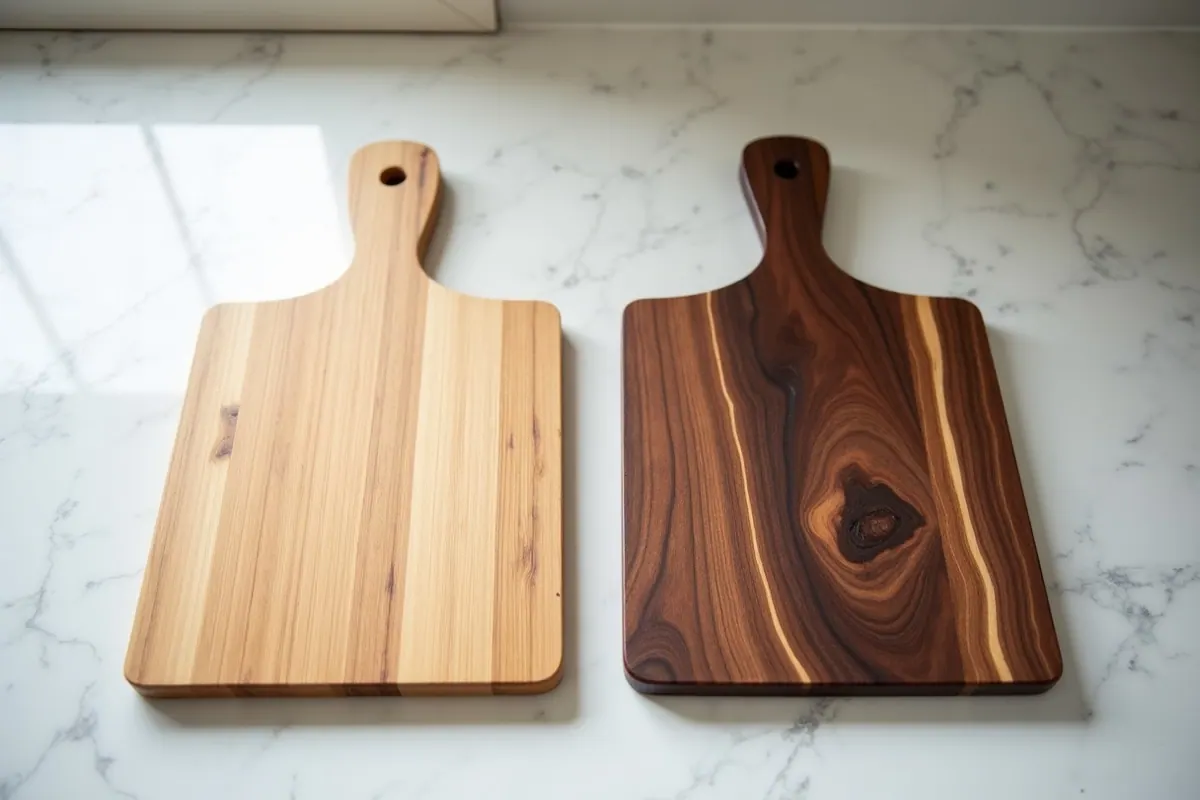
This surprises people. Bamboo is a grass, and a fast-growing one: harvested in three to five years rather than the decades a hardwood needs. The boards are made by pressing strips together under heat and resin, which is why the surface looks like fine parallel lines rather than the wandering grain of a tree.
That construction has consequences you can see. The density is uniform across the whole face, so a burn lands the same in one corner as it does in the other. It also means the board is a laminate rather than one solid piece, which is why standing water is the one thing it genuinely will not tolerate: water sits in a glue line and eventually opens it.
Our bamboo board is 12in x 7.8in x 0.5in, with an integrated handle cut into one end and a juice groove channeled around the face. The handle is the part people notice. It turns the board into something you lift with one hand and carry loaded, which a plain slab is not.
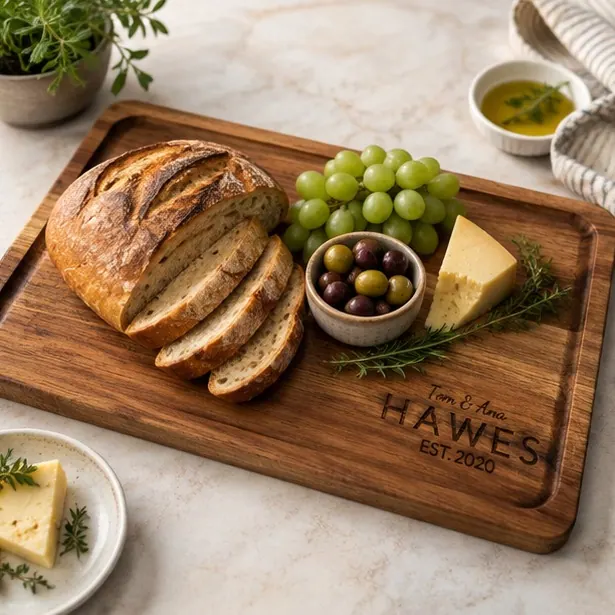
Acacia is a genuine hardwood, and every board is visually different because the tree was. You get color movement from honey through to chocolate, sometimes within a single board.
Our acacia board is 12in x 8in x 0.6in. That makes it fractionally wider than the bamboo and about a fifth thicker, and because none of its length is given over to a handle, more of the rectangle is usable surface. Its face is flat and unbroken, with no juice groove, so food lays out across the whole of it. That is the right call for a cheese board and the wrong one for a roast, because nothing stops a liquid reaching the counter.
The trade is that grain competes with engraving. On a busy piece of acacia, a delicate script has to fight the wood for attention. On a calm piece it looks extraordinary.
| Bamboo with handle | Acacia | |
|---|---|---|
| Material | Strips pressed with resin | Solid hardwood |
| Dimensions | 12in x 7.8in x 0.5in | 12in x 8in x 0.6in |
| Thickness | 0.5in | 0.6in |
| Surface | Uniform pale lines | Variable grain, honey to chocolate |
| Engraving contrast | Crisp, pale, high contrast | Deeper burn, competes with grain |
| Handle | Yes, integrated into one end | No |
| Price | $32.99 | $39.99 |
The engraving is a burn, not a print, so there is nothing on the surface to wear off. But the two woods take that burn differently.
Bamboo's uniform density means the burn is even and predictable. Fine lines stay fine. A split monogram, where a large initial sits behind a name, holds its edges cleanly on bamboo even at small sizes.
Acacia varies in density across a single board, so the same file burns marginally darker in some places than others. On most pieces that reads as depth. On a very figured board it can read as unevenness, which is why heavy-script designs like Script The Last's tend to look best on the calmer pieces.
If you want the engraving to be the loudest thing on the board, choose bamboo. If you want the wood to be, choose acacia.
A couple setting up a first kitchen. Bamboo. It is the cheaper of the two, and the handle makes it the board they reach for rather than the one they display. See wedding gift ideas for what to engrave.
Someone who already has a well-equipped kitchen. Acacia. They own boards. What they do not own is a beautiful one with their own name burned into it.
A gift going on a wall or a counter. Acacia, every time. The grain photographs better, and it reads as an object rather than a tool.
Anyone who carries a board loaded, to a table or out to a grill. Bamboo, for the handle. A one-handed lift instead of a two-handed balancing act is the entire reason the handle is cut into it.
A realtor closing gift or a bulk order. Bamboo, usually. The $7.00 difference multiplies across a run, and the handle makes it read as a tool rather than an ornament. Bulk pricing starts at ten boards.
A grandmother or a parent. Acacia, if they will display it. Bamboo, if they cook every day and would rather have something they can grab by the handle off a rack. Our guides on gifts for mom and for grandma go further into this.
Identical, and simple: hand wash, dry it standing on its edge rather than flat, and rub food-safe mineral oil into it every month or two. Never the dishwasher. The heat and the hours of standing water will split either wood, and that is the one mistake that actually ruins a board.
Acacia shows oil more dramatically; the grain darkens and the color deepens. Bamboo changes less. Both benefit from it. The full care guide covers what to do if a board dries out or gets stained.
Neither is better outright, and the differences worth deciding on are short. Acacia is thicker at 0.6in against 0.5in and carries visible grain, which most people read as the more expensive-looking object. Bamboo is $7.00 cheaper, takes a higher-contrast engraving, and is the only one of the two with a handle. Choose acacia if the board is mostly going to be looked at, bamboo if it is mostly going to be carried.
Bamboo gives higher contrast, because the pale, uniform surface has nothing competing with the burn. Acacia gives a deeper, richer engraving that sits within the grain rather than on top of it. Bamboo is easier to read from across a room; acacia rewards being looked at closely.
Bamboo regrows in three to five years against decades for a hardwood, and it regenerates from the same root system without replanting, so on renewability it has a genuine advantage. The boards are made with resin binders, so it is not a pure natural material. But the raw input is among the fastest-renewing available.
You can. Both woods are food-safe across the entire surface. Blade contact will soften the lettering over years, though, so the arrangement most people land on is knife work on the plain reverse and the engraved face kept for serving. That is what keeps one of these a keepsake rather than a scratched kitchen tool.
Any hard surface takes something off an edge, and both of these are hard surfaces. We have no hardness measurement for the specific boards we sell, so we are not going to hand you a number that sounds authoritative and is not. In practice it matters less than the question suggests, because an engraved board is rarely anyone's main prep board: the knife work goes on the plain reverse and the engraved face stays for serving.
Yes, and it costs less than two separate orders. Shipping is $8.00 for the first board and $4.00 for each additional board in the same consignment, so a bamboo and an acacia together ship for $12.00 rather than $16.00. Both woods carry all three layouts, so the two boards can match or deliberately not.
Both woods carry all three engraving layouts, so the design decision and the wood decision are independent. Start with the layout you like in the shop, then pick the wood on the product page. The price updates as you switch, and the preview shows your names on the board before you order. If the board is mainly going to serve rather than prep, charcuterie board versus cutting board covers what changes.
First names, last name and an optional EST year in the most versatile layout on the site.
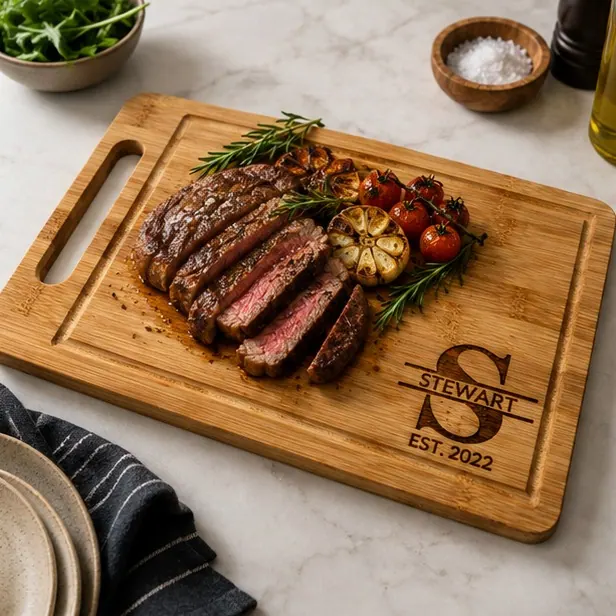
A timeless split layout with your initial, last name and optional EST year.
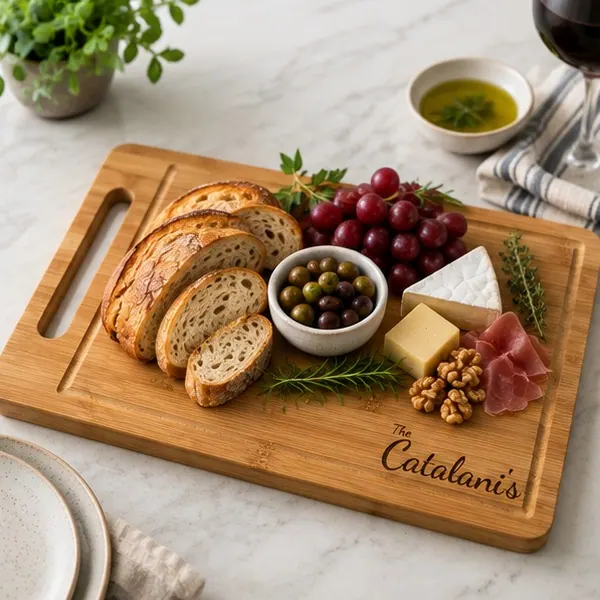
Soft script styling with an heirloom feel, especially strong for wedding gifting.
A butcher block is a thick end-grain or edge-grain surface that mostly stays put. A cutting board is a tool yo
Personalized means something gets made after you order, so it is not a same-day category. Here is the real tim
What to give parents who say they want nothing, how to split one gift between siblings, and what to engrave wh