
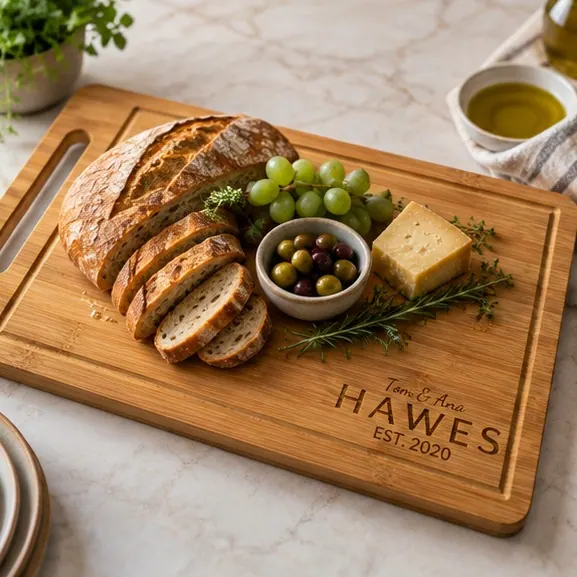
Classic Last Name
First names, last name and an optional EST year in the most versatile layout on the site.
$32.99–$39.99
Home › Guides › How Laser Engraving Works on Wood, and Why It Is Permanent
12 min readA laser burns and removes wood rather than printing on it, which is why the mark cannot peel or wash off. What changes with the wood, the oil and the years.
A laser engraves wood by burning it. Focused light heats a very small spot on the surface until the wood chars and some of it is driven off as smoke, and what is left behind is a dark, slightly recessed mark made out of the board itself.
Nothing is added. There is no ink, no paint, no coating and no film, which is the reason the mark cannot chip, peel, fade in a wash or come off with oil. It is not on the wood. It is the wood.
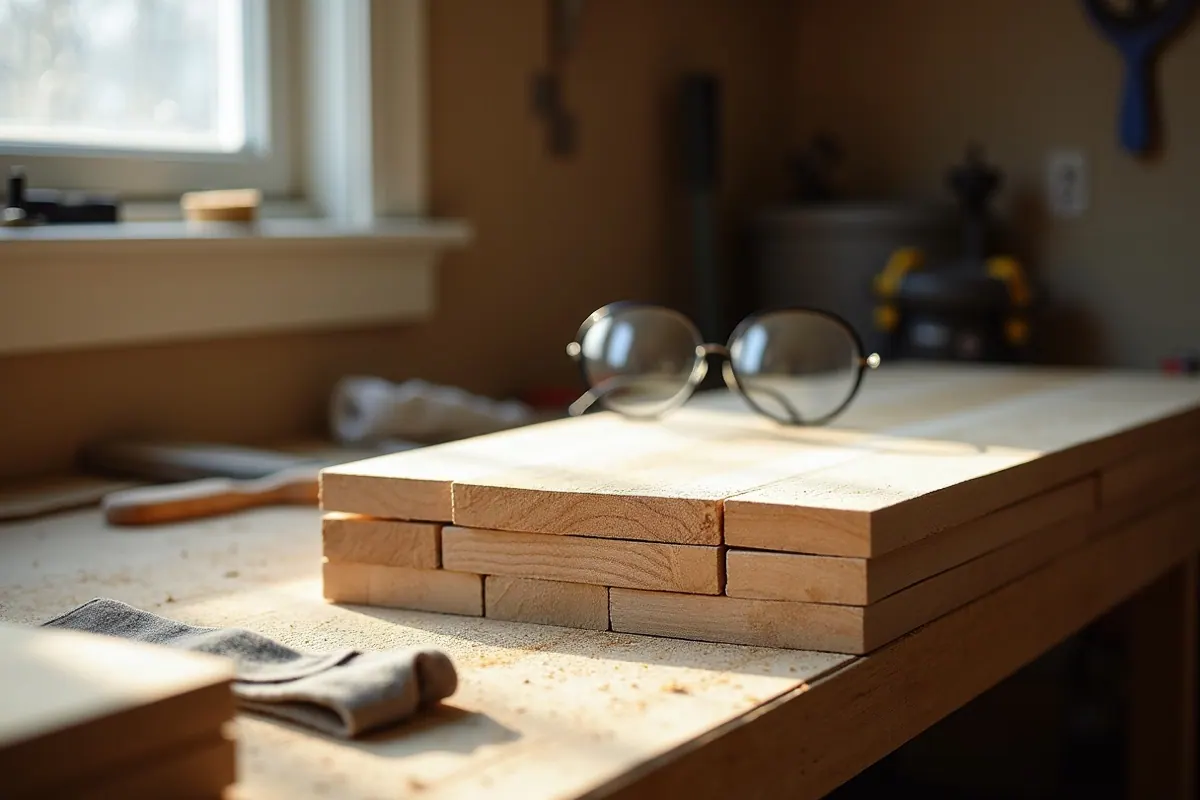
In general terms, the process is a controlled burn moving very fast.
A beam of light is focused down to a small point on the surface of the board. Where it lands, the wood absorbs the energy as heat. Two things then happen almost at once: the surface chars, which is what makes the mark dark, and a small amount of material is removed as smoke and fine ash, which is what makes the mark recessed.
The beam moves across the wood line by line, switching on where the design is dark and off where it is not, in the same way a printer scans a page. What it leaves behind is a shallow relief map of the artwork, burned into the board.
Three consequences follow from that, and they are the whole reason people ask how this works.
The mark is made of the material, not applied to it. You cannot delaminate it, because there is no layer.
The mark is shallow. This is surface work, in the range of a fraction of a millimeter on a board half an inch thick. It does not weaken the board and it does not go through.
The mark is bare wood. Charred wood, but wood. It is not sealed, coated or finished in any separate way, and it is oiled exactly like the rest of the board. Both faces are food-safe, which is what we say about the finish itself rather than any claim about the engraving doing something to the surface. It does not.
Compare it to the two other ways a name gets onto a wooden object.
| Laser engraving | Printing | Vinyl or decal | |
|---|---|---|---|
| What is on the board | Nothing. Material has been removed | A layer of ink on top of the surface | A cut adhesive film stuck to the surface |
| How it fails | Abrasion of the wood itself, over many years | Scratching, fading, gradual wear from washing | Edges lift, then the whole piece peels |
| Survives hand washing | Yes | Depends entirely on the ink and any topcoat | Water eventually gets under the edges |
| Survives oiling | Yes. Oil cannot lift a burn | Risk of smearing or softening, depending on ink | Oil attacks the adhesive directly |
| Can be felt | Yes, as a shallow recess | No, or as a slight raised film | Yes, as a raised edge you can catch a nail on |
| Under a knife | Wears slowly, softening letter edges | Removed quickly | Removed immediately |
| Repairable | Sanding removes it entirely. Do not sand it | No | Peel and reapply |
| Looks like | Part of the board | Something printed on a board | Something stuck to a board |
The short version: printing and vinyl both put something on top of the wood, so both have an interface that can fail. Engraving has no interface. There is nothing between the mark and the board because they are the same object.
This is also why an engraved board ages differently from a printed one. A printed board looks progressively worse as the ink wears unevenly. An engraved board just looks older, in the way wood does, and the mark ages with it.
Run a finger across a finished board and you can feel the lettering as a very shallow dip. That is not a flaw and it is not roughness. It is the material that was removed.
How deep the recess is depends on how much energy went into the surface, which is why a bold solid initial feels a little deeper than fine script does. In every case it is shallow enough that the board sits flat, wipes clean and serves food without anything catching in it.
Two practical notes that come out of this. A slightly recessed mark collects a little more oil than the flat surface does the first time you oil the board, which is normal and part of why the engraving darkens. And the recess is the reason the design survives light surface wear: a scuff that would take ink off the top of a board only touches the shoulders of an engraved letter.
The same design engraved on two different boards does not look the same, and this catches people out when they compare photographs.
The mark itself is char, and char is close to the same dark brown-black whatever wood produced it. What changes is the background it sits on.
On a pale surface, the contrast is high. Bamboo is the bright, light, even-toned option here, and a burn on it reads as strong dark lettering on a light field. That is the crispest, most legible version, and it is the one that photographs most clearly.
On a darker surface, the contrast is lower and the effect is different rather than worse. Acacia has a richer, browner, more variable grain, and the engraving sits into it rather than jumping off it. Some people prefer this: it reads as older and more furniture-like, and less like a label.
Grain matters as well as color. Wood is not uniform, so a line crossing a dense band and an open one does not char identically, and on a strongly figured board the lettering picks up a little of that variation. That is the nature of engraving a natural material and it is part of why no two boards are quite identical.
If the choice between the two woods is what you are actually trying to settle, bamboo vs acacia cutting boards goes through it properly, and how to choose the right engraved cutting board design approaches the same decision from the kitchen the board is going into.
This is the question people worry about most, and the answer is the reassuring one: oiling makes the engraving read better, not worse.
Boards ship unoiled, so the first coat is the owner's job, and it is the coat that changes the look most.
Use food-grade mineral oil, or a board cream that is food-grade mineral oil with beeswax blended in. The best oil for a cutting board covers which bottles to avoid and why, and how to care for a wooden cutting board has the full washing, drying and oiling routine.
Not washing. Not oil. Not sunlight in any timescale that matters for an object kept indoors. One thing: a knife blade.
Cutting directly on the engraved face takes material off the top surface, and because the lettering is a shallow recess, taking material off the surrounding surface is exactly how you make the recess shallower. It does not happen in a month. Over years of daily prep on that face, the edges of the letters soften and the fine parts go first.
The arrangement almost everyone arrives at without being told is the right one: the blank back is for knife work, the engraved face is for serving and display. Both faces are food-safe, so this is purely about keeping the keepsake looking like one, and it happens to be the same arrangement that keeps raw prep away from a surface you serve from.
The one thing that removes an engraving quickly is sanding. Sanding is the standard fix for a rough or scarred prep face, and it is exactly why the care guide says to sand the back and never the engraved face. There is no depth of engraving that survives being sanded flat, because the mark and the surface are the same material.
Permanence is usually written about as a source of anxiety, which is only half true and it is the wrong half.
The mark is permanent once it is made. What is not fixed in advance is the text, and there are two things standing between you and a board with the wrong spelling on it.
Every order gets a confirmation showing the exact text that will be engraved, exactly as it was typed. Nothing goes on the laser before that. If a letter is wrong, or an apostrophe is in the wrong place, or the year is a digit out, replying to that email fixes it with no cost and no argument.
A board engraved wrong against what you confirmed is remade, at no cost, with nothing to send back. And a board that arrives damaged is remade on a photo sent within 14 days.
So the honest framing is not "get it right or live with it". It is "check the confirmation email, which takes ten seconds, and then the permanence is entirely on your side". If you are still deciding what the text should be, cutting board engraving ideas covers the formats that fit and the ones that age badly, and how to choose the right personalized cutting board design maps the occasion to the layout.
Yes, because there is nothing on the wood that could come off. The laser removes and chars material, so the mark is a shallow recess made of the board itself rather than a layer sitting on top of it. Hand washing, oiling and ordinary use do not affect it. The only two things that remove it are sanding the engraved face and years of cutting directly on it with a knife.
A focused beam of light heats a very small spot on the surface until the wood chars and part of it is carried away as smoke, and the beam scans back and forth across the board switching on and off to follow the design. What is left is a darkened, slightly recessed version of the artwork burned into the surface. The process adds nothing to the wood; it only removes and darkens.
No. Engraving is surface work, shallow enough to be measured in fractions of a millimeter on a board half an inch or more thick, so it takes off a tiny fraction of the depth. It does not weaken the board, does not show on the other face, and does not create anywhere for water to get in beyond what any wood surface already has.
Because the burn is roughly the same color regardless of the wood, so what changes is the background. A pale, even surface like bamboo gives high contrast and very crisp lettering, while a darker, more figured wood like acacia gives a lower-contrast mark that sits into the grain. Grain variation within one board can also make a single line char slightly differently along its length.
No, and it usually improves it. Oil darkens the surrounding wood more than it darkens the already-charred mark, so the contrast holds and the lettering tends to read more clearly on an oiled board than on a dry one. Oil both faces, including the engraved one, and wipe off whatever has not soaked in.
Chemically it is the same thing, which is wood being charred by heat, and the difference is the tool and the precision. A hand-held pyrography iron burns by contact, one stroke at a time; a laser burns with focused light, scanning a design at a resolution no hand can hold. The result on the wood is comparable, so a laser-engraved mark is as permanent as a hand-burned one.
Yes. The engraved areas sit slightly below the surrounding surface, because material was removed to make them, so a fingertip run across the lettering picks up a shallow dip. Bolder, more solid parts of a design tend to feel a little deeper than fine strokes. It is shallow enough that the board still sits flat and wipes clean normally.
Only by sanding, and sanding takes it off completely rather than partially, because the mark and the board are the same material. That is the reason to sand the blank back of a board when it gets rough and never the engraved face. There is no solvent, wash or treatment that lifts an engraving, since there is nothing sitting on top of the wood to dissolve.
The difference between reading about contrast and seeing it is large, and it is the reason both woods are worth looking at with your own text on them rather than someone else's.
The shop previews all three layouts in both woods with the names and year you type in, so you can see how a bold split monogram sits on acacia against how script reads on bamboo before anything is burned. The bamboo board is $32.99 at 12in x 7.8in x 0.5in with an integrated handle and a groove channeled around the face, and the acacia is $39.99 at 12in x 8in x 0.6in with a flat unbroken face. Whichever you pick, the confirmation email shows the exact text first, and the first coat of oil is the thing that makes the engraving look the way it will look for the next twenty years.
First names, last name and an optional EST year in the most versatile layout on the site.
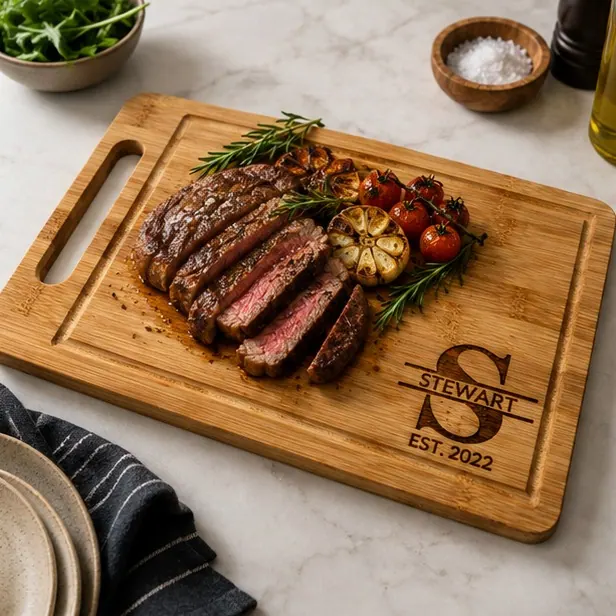
A timeless split layout with your initial, last name and optional EST year.
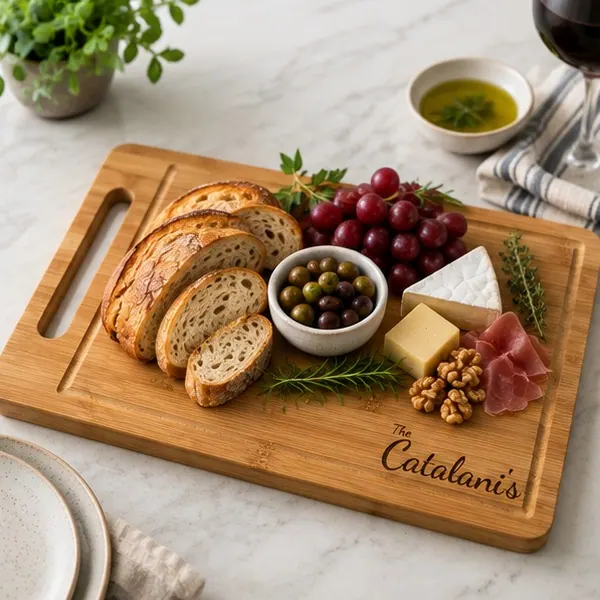
Soft script styling with an heirloom feel, especially strong for wedding gifting.
A butcher block is a thick end-grain or edge-grain surface that mostly stays put. A cutting board is a tool yo
Personalized means something gets made after you order, so it is not a same-day category. Here is the real tim
What to give parents who say they want nothing, how to split one gift between siblings, and what to engrave wh