
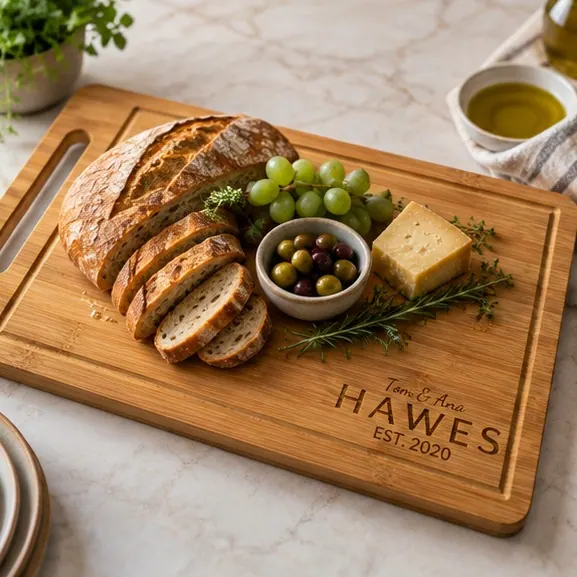
Classic Last Name
First names, last name and an optional EST year in the most versatile layout on the site.
$32.99–$39.99
Home › Guides › Wood vs. Plastic Cutting Boards: Which One Should You Use
10 min readWhat the evidence supports about bacteria on wood, where plastic genuinely wins, what each does to a knife edge, and why most kitchens end up wanting both.
Own both, and split the work: plastic for raw meat, poultry and fish, wood for produce, bread, cheese, cooked food and anything going on a table. That is unsatisfying if you came here hoping one material would win outright, and it is what most careful cooks actually do.
Here is the honest version of each argument, including the ones that do not favor wood.
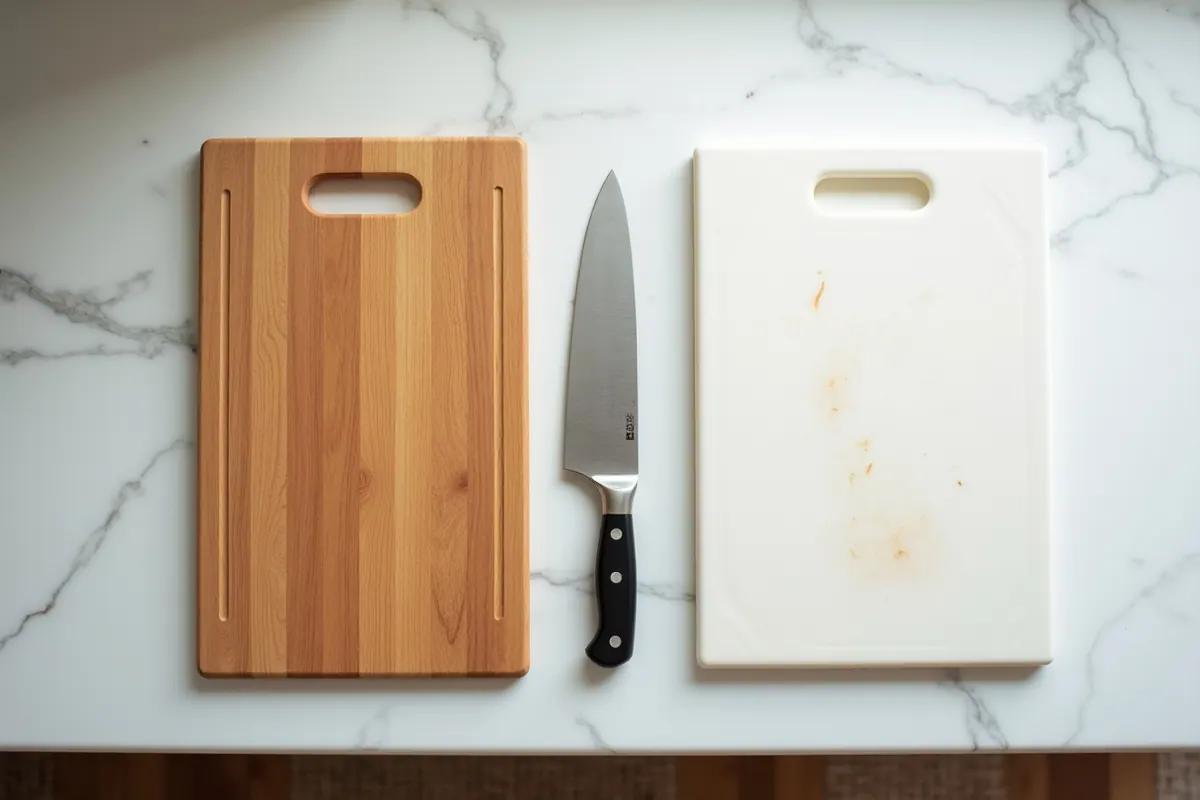
| Wood | Plastic | |
|---|---|---|
| Dishwasher | Never. Hand wash, towel dry, stand it on edge | Yes, and this is its single strongest argument |
| Raw meat | Safe if washed properly, but harder to feel certain about | The sensible default if you want machine sanitizing |
| Knife scarring | Fibers part and close, and scars sand out | Cuts stay open and collect residue |
| Repair | Sand with 220-grit and re-oil | None available. Deep grooves mean replace it |
| Lifespan | Decades, on about four minutes of care a month | A year or a few years of hard use |
| Maintenance | Food-safe mineral oil every month or two | None |
| Warping | Possible if left wet or lying down flat | Uncommon, though thin boards can bow in a hot cycle |
| Cost | Higher: $32.99 in bamboo, $39.99 in acacia here | Low enough to buy a color-coded set |
| On a table | Serves food. It is furniture as well as a tool | Looks like equipment, because that is what it is |
| Microplastics | None | Reported in recent work, significance unsettled |
| Handling | Heavier, stays put under a knife | Light, flexible, easy to scrape from into a pan |
People assume plastic is safer because it is nonporous, and nonporous sounds cleanable. That assumption is also why commercial kitchen codes have long leaned toward plastic: a surface you can specify, sanitize and document is easier to regulate than a natural material that varies board to board.
What laboratory food-science work has found repeatedly since the early 1990s is that the expected advantage does not show up. In broad terms, bacteria applied to wood surfaces tended to decline rather than persist, while surviving more readily on plastic, and heavily scarred plastic was harder to clean than heavily scarred wood. That is the general shape of the findings, and it is as specific as this page will get: we are not going to hand you a study title we cannot put in front of you.
Three things follow.
Wood is not disinfecting your board for you. Whatever a wood surface does on its own is no substitute for hot soapy water, and "wood does better in the lab" is not permission to rinse and move on.
Grooves are the real variable, in both materials. US food safety guidance emphasizes keeping raw meat separate from ready-to-eat food, washing properly between jobs, and replacing or resurfacing any board whose cuts have got too deep to clean out. A smooth board of either material is fine. A trenched board of either material is a problem.
Microplastics are a live question rather than a settled one. Recent work has reported that chopping on plastic releases plastic particles into food, which is unsurprising given that chopping visibly removes material. What that means for health is not established, and anyone stating it confidently in either direction is ahead of the evidence.
This is the part most wood-board articles skip, so it goes before the wood case rather than after it.
The dishwasher. This is the whole argument and it is a strong one. Sustained heat, detergent, a full cycle, and no judgment call from you about whether you scrubbed enough. If you break down chicken thighs on a Tuesday night and want the board handled rather than carefully hand washed, plastic is the correct tool. Wood cannot do this at all: a dishwasher is the one thing that reliably destroys a wooden board, which the care guide explains in detail.
Cost. Plastic is cheap enough that buying three and assigning them to raw meat, produce and everything else is reasonable. Color-coding boards by food type is a good habit, and plastic is the only material where it is affordable.
Weight and flex. A thin plastic board bends, so you can fold it and pour diced onion into a pan without losing half of it to the stovetop. A half-inch hardwood board does not bend, and you use a bench scraper instead.
No maintenance, and no guilt. Plastic needs no oil, no drying on edge and no thinking about, and when it is finished, replacing it is not a decision.
It can be repaired. A wooden board that has gone gray, scarred and tired gets sanded along the grain with 220-grit, oiled over a few days, and is functionally new. There is no equivalent for plastic: every cut in a plastic board is permanent, and the board's life is the sum of them.
It lasts. A board that gets hand washed, dried standing on edge and oiled every month or two lasts decades. The failure modes are not wear: they are being left wet and being put in a dishwasher, and both are avoidable in a sentence.
It can go on the table. This is the use plastic cannot cover at all. Cheese, bread, charcuterie, a rested steak, a spread for people to help themselves from. A presentable board is doing two jobs, and charcuterie board versus cutting board covers keeping those jobs from interfering with each other.
It can be engraved, which is why a wooden board works as a gift and a plastic one does not. A family name and a year burned into the face turns a kitchen tool into something that gets kept.
It stays put. Weight is an advantage under a knife. A light board skates unless you put a damp towel under it.
What is genuinely settled is that both wood and plastic are far kinder to an edge than glass, stone, ceramic or a metal tray. Those are the surfaces that wreck knives, and no board comparison matters next to avoiding them.
Between wood and plastic the difference is small, and we have no hardness measurement for the specific boards we sell, so we are not going to give you a number that sounds authoritative and is not. What people notice has more to do with setup than material: a board that slides, and a surface already trenched with old cuts, do more to an edge than the choice between plastic and hardwood.
A plastic board is done when the cuts are too deep to get clean, or when the surface has gone rough and holds stains and smells. Both arrive faster than people expect on a board taking daily knife work, and neither is fixable.
A wooden board is done when a glue line splits or a crack opens through it, which in practice means it went through a dishwasher or sat soaking. Short of that, everything a wooden board suffers is reversible: stains come out with coarse salt and lemon, roughness sands away, and a cupped board flattens under a weight overnight.
Two boards, one needing nothing and one needing four minutes a month, and the raw-and-ready-to-eat problem is solved for good.
Plastic, for most home kitchens, and the reason is the dishwasher rather than the material. Sustained heat and detergent with no effort from you removes the judgment call about whether your hand washing was thorough enough. A wooden board is perfectly safe after raw chicken if you wash both faces and the edges in hot soapy water with a brush, dry it, and sanitize with diluted white vinegar or 3% hydrogen peroxide, but that is several deliberate steps rather than one.
Mostly plastic, for reasons that are about running a regulated commercial kitchen rather than about which surface is better. Plastic can be specified, color-coded by food type, sanitized in machinery and swapped out cheaply when an inspector flags it, and certified foodservice equipment has long favored nonporous surfaces. Plenty of kitchens still use wood on the pass and for bread and cheese service.
Recent research has reported that they do, which makes sense given that chopping visibly removes material from the surface. The health significance has not been established, and the honest position is that this is an open question rather than a settled reason to throw out your plastic boards. It is one more argument for keeping plastic to the raw meat job and using wood for everything that gets eaten straight off the board.
When the knife grooves are deep enough that you cannot get them clean, when the surface has gone rough and holds stains and smells, or when it has warped enough to rock under a knife. There is no way to resurface plastic, so the grooves only ever get worse. This is the practical difference from wood, which can be sanded flat and oiled back to new.
Yes, and that is the main reason to own one. Check that the board is dishwasher-safe, since some thinner and composite boards bow or discolor in a hot cycle, and give it the top rack if it is thin. A wooden board must never go in: sustained heat and hours of standing water split glue lines and check the surface, and none of it can be undone.
Bamboo behaves like a wooden board in every way that matters here: it hand washes, it takes oil, it can be sanded, it lasts for decades, and it can be engraved and put on a table. It also cannot go in a dishwasher, and bonded strips make it particularly unforgiving about soaking. So the split is the same one as for any wood: bamboo for produce, bread, cheese and serving, plastic for raw meat.
Two is enough for most households: one plastic board reserved for raw meat, poultry and fish, and one wooden board for everything else, with its plain back used for knife work and its presentable face used for serving. Three makes sense if you cook a lot, adding a second wooden board so one can be drying while the other works. Beyond that you are buying storage problems rather than capability.
Buy the plastic one for raw meat first, because it is cheap and it solves the part of this that genuinely matters. Then buy a wooden board good enough to leave out, because that is the one still in the kitchen in twenty years.
Ours are made for the second job: 12in x 7.8in in bamboo with a handle and a groove channeled around the face, or 12in x 8in in acacia with a flat unbroken face. See all three layouts with a live preview of your own text, or read what size cutting board you need first, since our size is a serving and gift board rather than a carving board. The bamboo board at $32.99 and the acacia at $39.99 both take a $6.00 gift box with a printed card of up to 200 characters.
First names, last name and an optional EST year in the most versatile layout on the site.
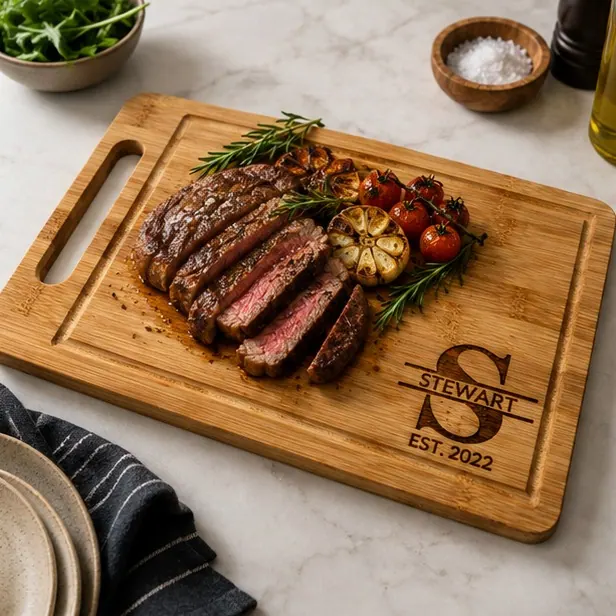
A timeless split layout with your initial, last name and optional EST year.
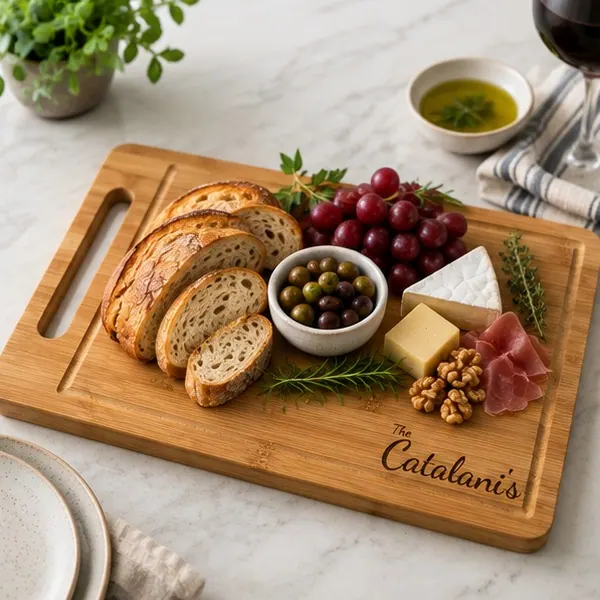
Soft script styling with an heirloom feel, especially strong for wedding gifting.
A butcher block is a thick end-grain or edge-grain surface that mostly stays put. A cutting board is a tool yo
Personalized means something gets made after you order, so it is not a same-day category. Here is the real tim
What to give parents who say they want nothing, how to split one gift between siblings, and what to engrave wh