
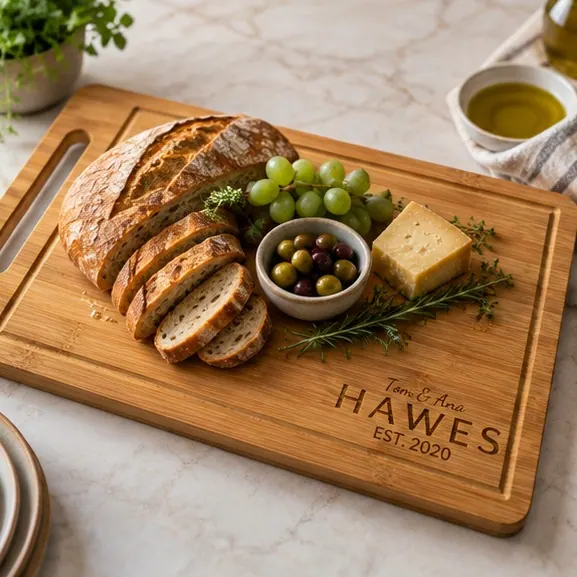
Classic Last Name
First names, last name and an optional EST year in the most versatile layout on the site.
$32.99–$39.99
Home › Guides › What Size Cutting Board Do You Need
10 min readThe real size ranges and what each is for, why counter depth and sink width decide it, the best size for a small kitchen, and how many people a board serves.
For everyday cooking, one board about 18in x 12in does the majority of the work in most kitchens, and that is the size to buy if you are only buying one. Everything else on this page is about the two things that actually override that answer, which are how deep your counter is and how wide your sink is, and about the jobs where a much smaller or much larger board is the right tool.
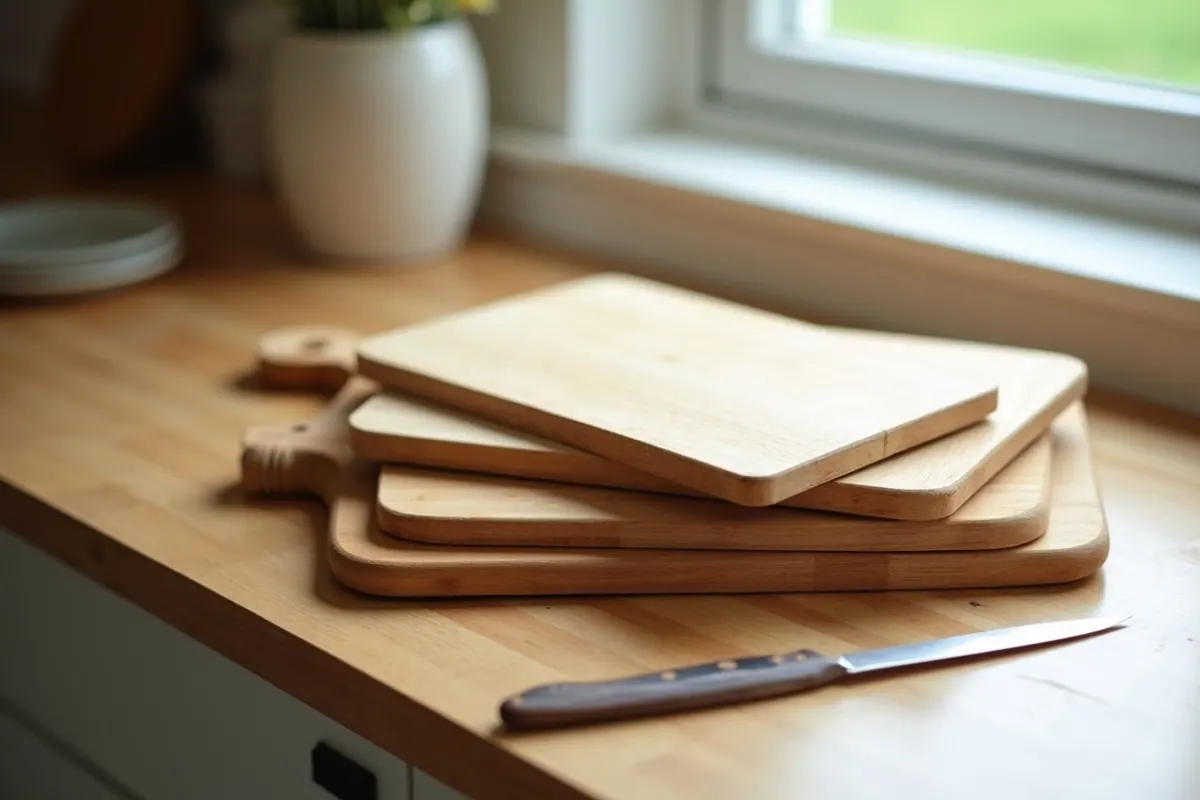
| Size | Flat area | What it does well | Where it falls down |
|---|---|---|---|
| Small, 8in x 10in to 12in x 8in | About 80 to 100 sq in | Cheese and bread, an appetizer spread for three or four, a lemon and a clove of garlic, a gift that lives out on the counter | A whole chicken, a big batch of vegetables, anything that needs a pile of scraps set aside |
| Medium, 15in x 11in to 18in x 12in | About 165 to 215 sq in | Everyday prep, a few vegetables at once with room to push them aside, still washes in a normal sink | Carving a large roast without the juices finding the edge |
| Large, 20in x 15in to 24in x 18in | About 300 to 430 sq in | Carving, a turkey, holiday and batch cooking, working two ingredients at once | Weight, storage, and a sink it will not lie down in |
| Extra large or over-the-sink, 24in and up | 430 sq in and up | Commercial prep, boards used as a work surface | Will not fit most domestic counters or sinks, and in hardwood it is heavy enough to need two hands every time |
Notice that the useful spec is flat area rather than the longest dimension. A long narrow board and a square one can measure the same across and give you very different amounts of room to work.
Almost every size guide talks about what you cook. The two constraints people actually hit are physical, and both are in your kitchen right now.
Counter depth. A standard base cabinet is 24in deep and the top overhangs to roughly 25in, so measure yours between the backsplash and the front edge, then subtract what a knife block, a kettle and the toaster take out of the back of it. Once a board is more than about 16in front to back there is nowhere left for the bowl you are scraping into, and you end up reaching across the board instead of standing square to it. Length along the counter is the forgiving direction. Depth is not.
Sink width. Measure the inside of the sink bowl, not the cabinet. If the board will not lie flat inside it, every wash becomes a two-handed job at an angle with water running off the end onto the floor, and a board that is awkward to wash is a board that gets left in the sink. A board left standing in water is absorbing it the entire time, which is the beginning of most of the problems in the care guide.
Somewhere to stand it on edge. Wood has to dry standing up, so it needs a rack, a gap beside a cabinet, or a stretch of backsplash to lean on. A board too tall for the space under your upper cabinets cannot be propped, and a board that dries lying down cups.
Measure all three before you fall in love with a size.
Somewhere between 12in and 15in long, and this is one of the few places where buying smaller is not a compromise.
In a galley or apartment kitchen the working counter is often one stretch beside the stovetop, and most of it is taken the moment anything else is out. A large board takes over the only clear surface, so it comes out, goes back and gets resented. A 12in to 15in board leaves room beside it for a bowl and a plate, washes in a small sink, and slides in beside the fridge or into a drawer.
Own two small boards rather than one big one. Two 12in boards give you more total area than a single 18in board, one can dry while the other works, and each is light enough to carry loaded. Running a plastic board for raw meat and a wooden one for everything else is the arrangement in wood versus plastic cutting boards, and it is the space-efficient answer as well as the hygienic one.
Prep wants thickness and depth. Serving wants flat, uninterrupted area and a board light enough to carry to a table with food on it.
That difference is why the two boards in a well-equipped kitchen are usually not two sizes of the same thing. The prep board is thicker, longer, plainer and lives near the stovetop. The serving board is thinner, prettier, easier to lift and lives where you can see it. Charcuterie board versus cutting board covers the rest of that split, including how one board can do both jobs if you keep the knife work on one face.
For serving, the number worth knowing is area per person: roughly 25 to 30 square inches of flat board each for an appetizer spread, or about 40 square inches each if the board is dinner. That scales linearly, so you can check it against any board you already own.
| Board | Flat area | Appetizer spread | Board as the meal |
|---|---|---|---|
| 12in x 8in | About 96 sq in | 3 or 4 people | 2 people |
| 15in x 11in | About 165 sq in | 5 or 6 people | 4 people |
| 18in x 12in | About 216 sq in | 7 or 8 people | 5 people |
For a bigger gathering, two or three medium boards spread along the table beat one enormous one. People can reach without queuing, it costs less, and the boards stay useful for everything else the rest of the year.
We make one size, in two woods, and being straight about what that size is for matters more than selling you into it.
Bamboo: 12in x 7.8in x 0.5in, with a handle cut into one end and a juice groove channeled around the face. Acacia: 12in x 8in x 0.6in, with a flat, unbroken face. Both weigh 15oz bare, so both carry easily in one hand.
What that size is genuinely good at. A cheese, bread and charcuterie spread for three or four. An engraved keepsake that lives out on the counter rather than in a cupboard. Light prep: a lemon, an onion, herbs, the small jobs that make up most weeknight cooking. Carrying food out to a table or a grill, which is what the bamboo handle is for. Fitting a small kitchen or a first apartment where an 18in board would not.
What it is not. It is not a carving board for a turkey, and we are not going to pretend otherwise. It is not a batch-prep surface for breaking down a squash or a whole chicken. It is not a center-table grazing board for twelve, and any twelve-inch board sold to you as one is being oversold. If a carving board is what you need, buy a 20in board with a deep groove, and buy ours for the job it does well: usually a gift, because at this size an engraved board reads as an object rather than as equipment, and it gets used the evening it arrives.
Around 18in x 12in, if the counter and sink allow it. That is enough area to prep several ingredients with somewhere to push them aside, and still small enough to wash in a normal sink and stand on edge to dry. Below about 15in you start working in stages, and above about 20in the board becomes a two-handed object that lives in one place.
Too small for daily prep as your only board, and exactly right for several other jobs. Twelve inches gives you about 96 square inches, which is an appetizer spread for three or four, a cheese and bread board, or light prep like a lemon, an onion and some herbs. It is also the size that fits a small kitchen, carries easily and works as a serving piece.
At least 20in x 15in, and a juice groove is not optional at that size. A turkey needs room for the bird plus room to put carved meat, and a large roast releases far more liquid than a groove-free board will hold. If carving is the job, buy a dedicated large grooved board and keep your smaller boards for everything else.
For a board that both preps and serves, 0.5in to 0.6in is the practical range: enough material to take a knife and stay flat, thin enough to lift, carry and slide into a rack. Dedicated prep boards go to 1in and beyond, which cuts better and warps less but is heavy enough that it stops being a board you move. Very thin decorative boards under about 0.4in cup and split if you work on them.
Yes, and it is a more common mistake than buying too small. A board deeper than about 16in leaves nowhere on the counter for the bowl you are filling, a board that does not fit the sink never gets washed properly, and a board too heavy to move one-handed stops getting carried to the table. Capability you cannot use in your own kitchen is not capability.
Two boards beat one in almost every kitchen, and they do not need to be two sizes of the same thing. The useful pair is a prep board sized to your counter and a smaller serving board that is presentable enough to put on a table. In a small kitchen, two 12in boards give you more total working area than one 18in board and are easier to wash, dry and store.
If you are buying for prep, measure your counter and your sink first and buy at the top of what they allow. If you are buying a board to serve from, to give, or to have out on the counter with a family name burned into it, twelve inches is the size that fits a life rather than a recipe.
The wood decides the face: acacia for a larger flat rectangle with no groove and no handle, bamboo for the handle and the channeled groove. See both in the shop with a live preview of your own text, compare them in bamboo versus acacia, or go straight to the acacia board at $39.99 if the flat serving face is what you want. Shipping is $8.00 for the first board and $4.00 for each additional board in one consignment, so a pair costs less than two orders.
First names, last name and an optional EST year in the most versatile layout on the site.
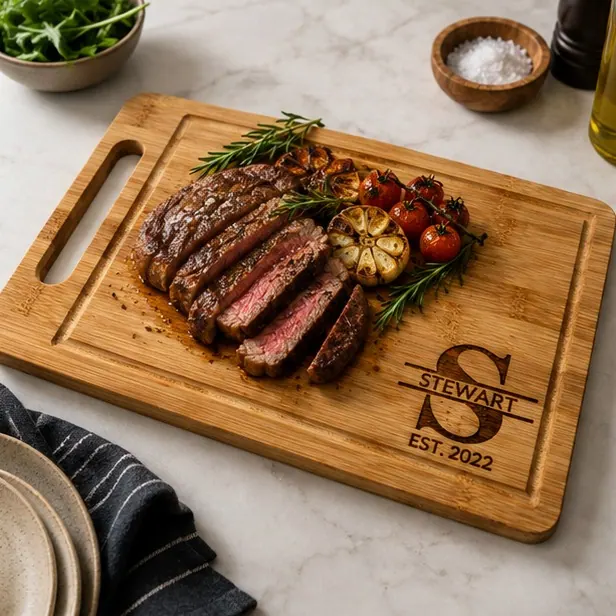
A timeless split layout with your initial, last name and optional EST year.
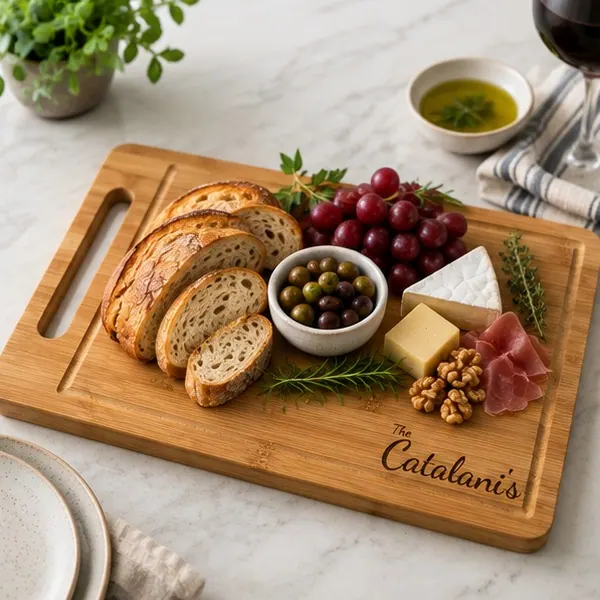
Soft script styling with an heirloom feel, especially strong for wedding gifting.
A butcher block is a thick end-grain or edge-grain surface that mostly stays put. A cutting board is a tool yo
Personalized means something gets made after you order, so it is not a same-day category. Here is the real tim
What to give parents who say they want nothing, how to split one gift between siblings, and what to engrave wh