
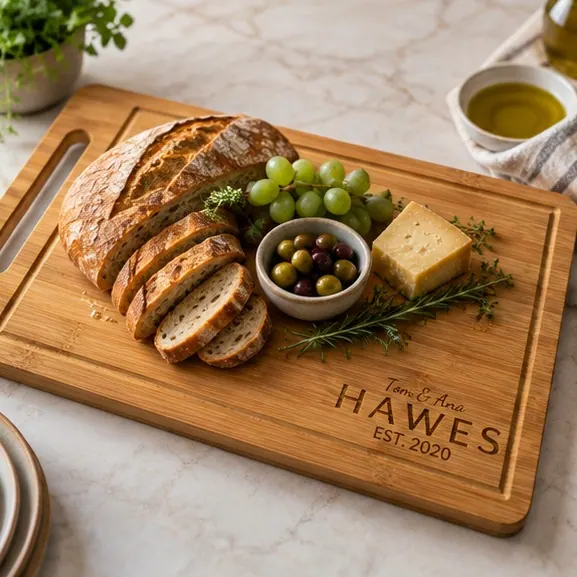
Classic Last Name
First names, last name and an optional EST year in the most versatile layout on the site.
$32.99–$39.99
Home › Guides › Charcuterie Board vs. Cutting Board: What Is Actually Different
9 min readWhat each term means, whether one board can do both jobs, the food safety rule that decides it, and how much food and flat area you need per person.
The two get sold as separate products, and the honest position is that the difference is smaller than the marketing suggests. Most charcuterie boards are cutting boards that nobody has ever cut on.
That said, there are real differences, and one genuine rule that decides whether a single board can do both jobs.
Worth stating plainly, because almost everything else follows from these two.
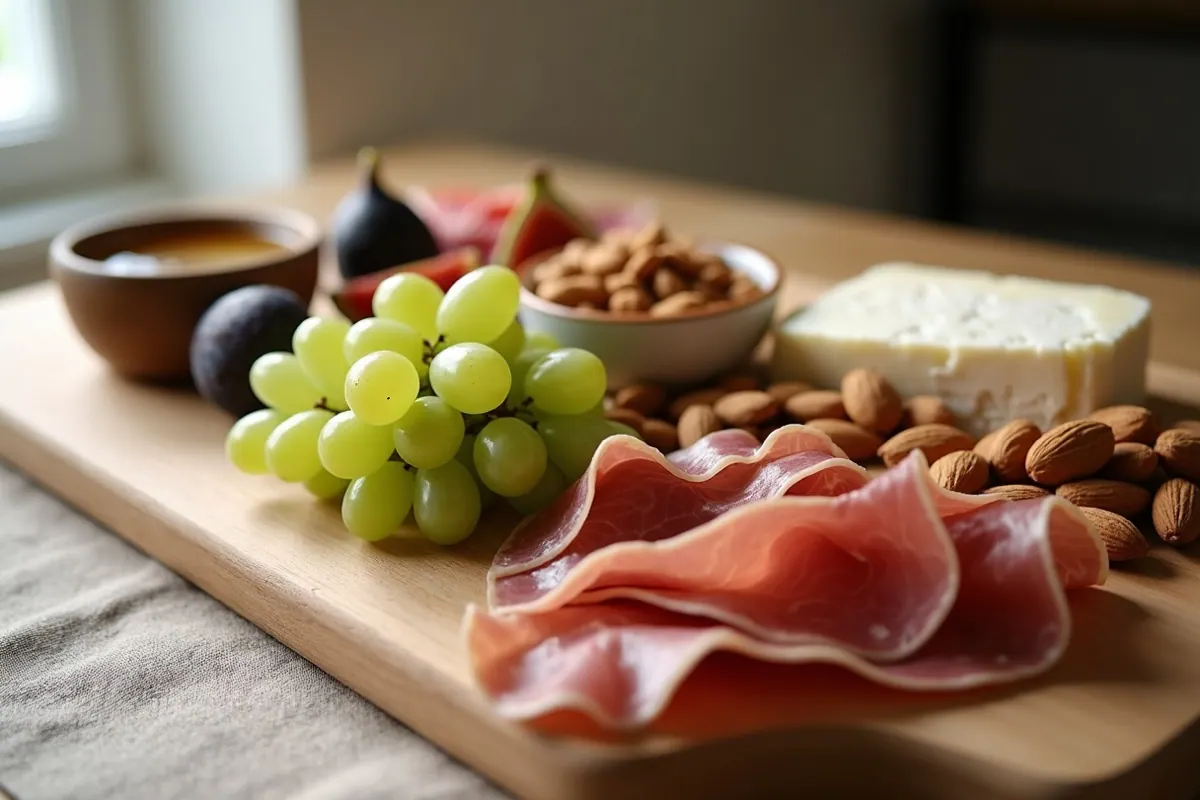
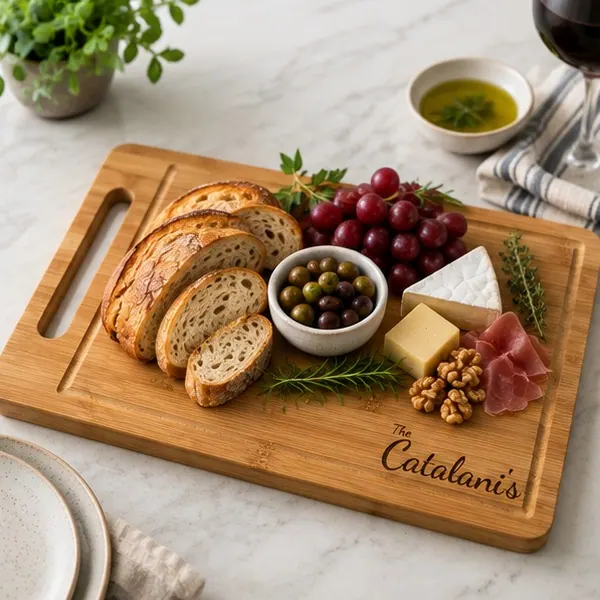
A charcuterie board is a flat serving surface that cured meats, cheeses and their accompaniments are laid out on for people to help themselves from, and nothing is cut on it.
A cutting board is a flat work surface that takes a knife edge, used for chopping and prep, and expected to pick up scars from doing so.
One is defined by what it carries, the other by what it takes. That is the whole distinction, and it is about use rather than about how either object was made.
| Cutting board | Charcuterie board | |
|---|---|---|
| Primary job | Take a knife edge | Hold food attractively |
| Thickness | Thicker, to resist cutting | Often thinner, easier to lift |
| Surface | Expected to scar | Expected to stay presentable |
| Shape | Rectangular, functional | Often irregular, live-edge, shaped |
| Finish | Food-safe oil | Food-safe oil, sometimes with wax |
| Engraving | Uncommon, gets cut through | Common, since nothing cuts on it |
| Handle | Useful | Useful, and often decorative |
| Juice groove | Helpful, since it catches what carving releases | Usually unwanted, since it eats flat serving area |
Notice what is not on that list: any difference in material, safety or construction. A hardwood board is a hardwood board. What separates them is what you do with the surface.
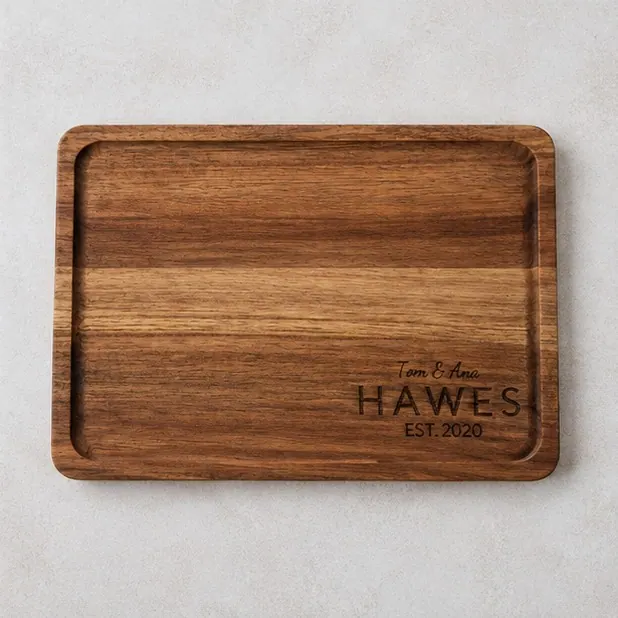
You can absolutely use one board for both, and the thing that makes it work is keeping the two jobs on different faces.
The plain back takes the knife work. Raw prep, chopping, anything that scars.
The engraved face serves. Cheese, bread, charcuterie, fruit, a rested steak. Nothing sharp, so the engraving stays crisp.
This is not a workaround invented to sell engraved boards. It is how most people end up using them anyway, because nobody wants to chop onions across a family name. It also solves the engraving's only real vulnerability, which is that cutting directly on a burn softens it over years.
This is the part worth getting right, and it is simpler than the internet makes it.
Raw meat, poultry and fish need to be separated from ready-to-eat food. Either use a different board, or wash the board thoroughly in hot soapy water and dry it before the ready-to-eat food goes anywhere near it. USDA guidance is to keep them separate; washing properly between uses is the practical version of that in a normal kitchen.
Wood is not the problem people assume. A well-maintained wooden board that is washed and dried properly is a perfectly sound surface. The failure mode is not the material, it is a board left wet, or a board carrying deep knife scars that never get cleaned out.
Deep cuts are the real risk, which is another argument for keeping the knife work on one face. A scarred surface is harder to clean than a smooth one.
If you are hosting and there is raw meat involved anywhere, the genuinely easy answer is a second board for the raw side. That is what two boards are for, rather than aesthetics.
Serving needs flat area, and flat area is the spec people misjudge most.
Our boards are 12in x 7.8in in bamboo and 12in x 8in in acacia. That is about 94 and 96 square inches of face, less whatever the bamboo handle takes out of one end. As a serving board, that is an appetizer board for three or four people. It is not a grazing spread for twelve, and anyone telling you a twelve-inch board is one is selling you something.
The rule of thumb worth knowing, which scales linearly and is easy to check against your own board:
| Per person | As an appetizer before a meal | When the board is the meal |
|---|---|---|
| Cheese | 2oz, across two or three types | 4oz, across three or four |
| Cured meat | 2oz | 4oz |
| Crackers or sliced bread | 5 or 6 pieces | 10 to 12 |
| Something briny and something sweet | A few olives and a spoon of jam or honey | Double, plus fruit |
| Flat board area | 25 to 30 square inches | 40 square inches |
So a twelve-inch board is four people with a drink beforehand, or two people for whom it is dinner. For eight, use two boards. For a party, use three and spread them along the table rather than buying one enormous one: people can reach without queuing, it costs less, and the boards stay useful for everything else the rest of the year.
Bamboo is 0.5in and acacia 0.6in here, which is the range that works for a board doing both jobs.
Thicker is better for cutting. More material to absorb knife edges, and less tendency to warp over years.
Thinner slides into a rack or the gap beside a cabinet, which is the constraint that decides where a board actually lives in a small kitchen.
Very thick end-grain butcher blocks are excellent cutting boards and poor serving boards, because nobody moves them once they are down. Very thin decorative boards are the reverse: they carry well and they cup and split if you work on them. Half an inch is where a board stops being specialized and starts being useful for both.
A persistent misunderstanding worth correcting.
Neither type should be varnished, lacquered or sealed with anything film-forming. A sealed board looks good until the film chips, at which point food gets under it and the board cannot be cleaned properly.
The correct finish for both is food-safe mineral oil, which soaks in rather than sitting on top, and which needs redoing every month or two. A board beading water is fine; a board absorbing it instantly is asking to be oiled. Board cream and beeswax blends do the same job with a little more water resistance.
Give a new board a coat of mineral oil before you put it to serious use, and another whenever it starts looking pale and thirsty. Two minutes, and it is what stops a board drinking up water and staining. The care guide has the whole routine, including how to bring a dry or stained board back.
Serving is the one use where appearance is the function, which changes the usual answer.
Acacia has genuine grain movement from honey to chocolate and photographs far better under food, which matters when the board goes on a table with people around it. At 12in x 8in it is the slightly larger rectangle of the two, and none of its length is given over to a handle, so more of it is surface you can lay food on. That makes it the grazing-board choice.
Bamboo is pale and uniform, takes a crisper engraving, has a handle cut into one end for carrying a loaded board, and has a juice groove channeled around its face. The groove cuts both ways: it is exactly what you want when carving something that releases liquid, and it is a border you have to arrange food inside of when you are building a spread.
So the split is about the face. Cheese, bread and a flat grazing spread: acacia, for the larger uninterrupted rectangle and the way the grain reads under food. Carrying a loaded board out to a table or a grill: bamboo, for the handle.
The full wood comparison covers how each takes the burn and wears over time.
Yes, and most charcuterie boards are exactly that. The practical approach is to keep the jobs on separate faces: knife work on the plain back, serving on the presentable front. That keeps the serving side unscarred and an engraving crisp.
Mostly use rather than construction. Charcuterie boards tend to be thinner, more decorative in shape and kept unscarred; cutting boards are thicker and expected to take knife damage. The material, the finish and the cleaning are the same for both.
Only after washing it thoroughly in hot soapy water and drying it, and it is safer to use a different board or a different face entirely. Raw meat, poultry and fish should be kept separate from ready-to-eat food, which is the one food safety point that genuinely matters here.
A twelve-inch board is about 94 to 96 square inches of face, which serves three or four people as an appetizer board or two people if the board is the meal. Allow roughly 25 to 30 square inches per person for an appetizer spread, or 2oz of cheese and 2oz of cured meat each. For a larger gathering, use two or three boards spread along the table rather than one enormous one, so people can reach without queuing and the boards stay useful for the rest of the year.
No, and they should not be. Varnish and lacquer chip, and food gets under the film where it cannot be cleaned out. Food-safe mineral oil is the correct finish for both board types, reapplied every month or two, optionally with a beeswax blend for a little more water resistance.
Not especially. A groove is designed to catch liquid released by carving, which a cheese and cracker spread does not produce, and it takes a border of usable surface out of the middle of the board. It is a real advantage on a carving board and a mild nuisance on a grazing one. Our bamboo board has one channeled around its face.
Acacia for a flat grazing spread. At 12in x 8in it is the larger rectangle, none of its length is taken up by a handle, and the grain photographs much better under food. Bamboo takes a sharper engraving, has a handle cut into one end for carrying a loaded board, and has a juice groove channeled around its face, which is what you want if carving or resting cooked meat is part of the job.
If you want one board that does both, take the engraved face as the serving side and the plain back as the working side, and it will handle both jobs for decades. Choose the bamboo if the board gets carried about and the acacia if it is mostly a serving surface. If you entertain often or cook a lot of raw meat, two is genuinely better, and shipping is $8.00 for the first board and $4.00 for the second in the same consignment, so a pair costs less than two separate orders.
See all three designs in both woods with a live preview of your own text, or read the best personalized kitchen gifts if you are buying one as a present rather than for yourself.
First names, last name and an optional EST year in the most versatile layout on the site.
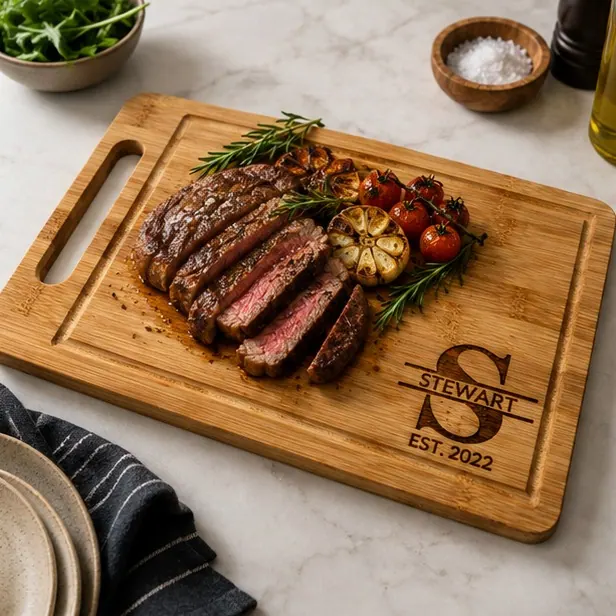
A timeless split layout with your initial, last name and optional EST year.
Soft script styling with an heirloom feel, especially strong for wedding gifting.
A butcher block is a thick end-grain or edge-grain surface that mostly stays put. A cutting board is a tool yo
Personalized means something gets made after you order, so it is not a same-day category. Here is the real tim
What to give parents who say they want nothing, how to split one gift between siblings, and what to engrave wh