
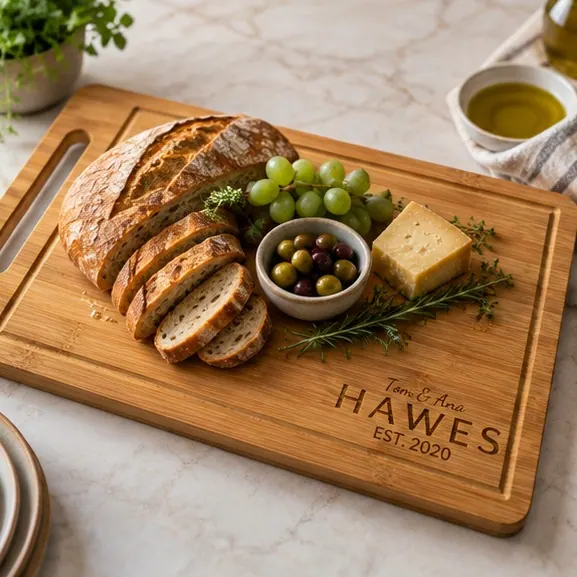
Classic Last Name
First names, last name and an optional EST year in the most versatile layout on the site.
$32.99–$39.99
Home › Guides › Best Personalized Kitchen Gifts
8 min readWhich personalized kitchen gifts are still used a year later, ranked by whether the personalization stays visible, and which ones hide it in a drawer.
Personalized kitchen gifts are the most reliable category in gifting, and most lists of them are ranked wrong. They rank by how useful the item is, when the question that actually decides the outcome is different.
Is the personalization still visible while the thing is being used?
An engraved knife is useful for twenty years, and the engraving is on the blade, in a drawer, seen by nobody. A monogrammed tea towel is used constantly, in a crumpled heap, face down. Both are fine gifts and neither gets any benefit from being personalized.
These are the ones worth the extra cost.
Engraved cutting and serving boards. Live on a counter, lean against a backsplash, or hang on a rail. Used for prep, used for serving, and seen every day. This is the top of the category and it is not close.
And yes, you can cut on them. It is the first thing people ask and the answer is short: the design is burned into the wood rather than printed on top of it, and both faces are food-safe, so nothing about an engraved board stops it being a board. Blade contact does soften the lettering over years, which is why most households settle on doing knife work on the plain reverse and bringing out the engraved face to serve from. It is a working object, not an ornament you are not allowed to touch.
Personalized serving platters and cheese boards. Same logic, brought out for company, which is when a name is most likely to be noticed by someone other than the owner.
Engraved wooden spoons displayed in a crock. Cheap, charming, and genuinely on show if the household keeps utensils out rather than in a drawer.
Custom recipe boxes. Out on a shelf, opened often, and if you fill it with handwritten cards from the family before giving it, close to unbeatable at any price.
Engraved decanters, glassware and bar pieces. Displayed if the household drinks, invisible if it does not. Know your recipient.
Still good gifts. Just do not pay extra for the engraving.
Engraved knives and knife blocks. Excellent gifts, twenty-year lifespan, personalization in a drawer.
Monogrammed aprons. Worn facing away from everyone in the room except the cook, then hung on a hook inside a cupboard door.
Custom tea towels and oven gloves. Used daily, seen crumpled, washed into fading within a year.
Personalized storage jars and canisters. Better than most of this tier, because they sit on a shelf, but only if the household keeps them out rather than in a pantry.
Engraved cast iron. Long-lived and visible on a stovetop, though the stamping is usually on the base.
Anything dishwasher-bound. Heat and long soaks destroy engraved wood and dull etched glass. Personalizing something that will be washed aggressively is paying for a feature that will not last.
Anything with a working edge. A personalized chopping surface that takes the knife directly will lose definition over years. It is the reason a board gets used with the plain face up for prep and turned over to serve.
Anything that personalizes information rather than identity. An address, a city, a "house rules" list. All of it has a shelf life. Names and dates do not.
This whole argument rests on the object staying visible, so counter space is the constraint worth checking before you buy.
In a galley kitchen or an apartment with three feet of usable counter, nothing stays out flat. What stays visible is what can go vertical: leaned against a backsplash, stood on edge in a rack, or hung from a rail. A 12in board does all three, and standing it on edge is also how it should be dried, so the storage and the care instruction are the same habit.
A large platter does none of those things and ends up in a cupboard, which drops it out of tier one however good it is. If you know the kitchen is small, buy the thing that can stand on its edge.
You have usually not seen the house properly. You do not know the color scheme, the wall space or how their taste translates to their own home.
The kitchen removes every one of those variables. Every house has one, everybody uses it, and a natural-finish wooden object is close to universally compatible with whatever is going on in the room, because wood is not a design decision in the way a color is.
That is why kitchen gifts outperform decor on gift occasions reliably rather than occasionally, and it is worth knowing when you are buying for a home you have never been inside.
| Recipient | What goes on it | Year? |
|---|---|---|
| A couple, married | Shared surname | Yes, wedding year |
| A couple, separate names | Both first names | Optional |
| A family | The plural surname | No |
| A new household | Surname plus first names | Yes, year of the move |
| A mother or grandmother | The family surname | No |
| A serious cook | Their own name | No |
The principle underneath: a name makes an object theirs; a name and a year makes it a record. Records get kept. Possessions get replaced.
Add a year only when there is an event to point at. A year on a gift for a parent refers to nothing, and can read as dating the relationship.
Three layouts here, in two woods. The split monogram is the most formal and photographs best; the script design is the warmest and reads as a home; the classic last name is the most versatile and carries the most information.
Bamboo at $32.99 is pale and uniform and takes a crisper engraving, and it is the one with a handle cut into it. Acacia at $39.99 is thicker at 0.6in, carries real grain movement, and reads as an occasion piece. The full wood comparison covers which suits which recipient, and choosing by kitchen style covers which suits which room.
Whatever you give, the care instruction is worth including, because wooden kitchen gifts are killed by two entirely avoidable things: the dishwasher, and being left flat and wet.
Hand wash, dry standing on edge, oil every month or two. The care guide has the full routine, and four lines of it in the card is what actually gets read.
An engraved cutting or serving board, because it is the one item where the personalization stays visible while the object is being used. Most personalized kitchen gifts, knives and aprons and towels among them, are useful but keep the name in a drawer, where it does nothing.
They are when the personalization is visible in normal use. Paying extra to engrave something that lives in a drawer buys nothing. Paying extra to engrave something that sits on a counter turns a replaceable tool into an object about the recipient, which is what stops it being thrown away.
Anything that goes through a dishwasher, anything with a working blade edge, and anything personalized with information rather than identity, such as an address or a city, both of which stop being true. Heat, long soaks and abrasion all shorten the life of an engraving.
Because the kitchen removes the variables you would otherwise be guessing at. Every house has one, everyone uses it, and a natural wood finish is compatible with a room you have never seen, unlike decor, which requires you to have guessed a color scheme correctly.
Only when it marks an event, such as a wedding or a move. A name makes the object theirs; a name and a year makes it a record of when something began, and records get kept. A year with no event behind it refers to nothing and is better left off.
Yes. The engraving is burned into the wood rather than printed onto it, so there is no coating to scratch off, and both faces are food-safe across the whole surface. Cutting directly on the lettering will soften it over years, so the common arrangement is prep with the plain face up and serving with the engraved face up. Wash in hot soapy water between raw and ready-to-eat food, and dry the board standing on its edge.
Something they would not buy for themselves, which usually means the personalized version of an item they already own in a plain form. Nobody buys themselves a board with their own name on it, which is exactly why it works as a gift.
See the three designs in bamboo and acacia, with a live preview so you can type the name and see it on the wood before ordering. If the occasion is a wedding, an anniversary or a new home, the combined guide covers what changes between them, and charcuterie board versus cutting board settles the serving question.
First names, last name and an optional EST year in the most versatile layout on the site.
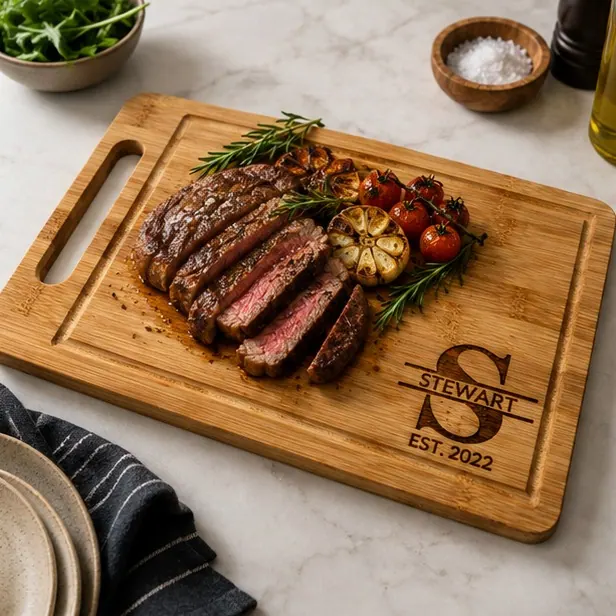
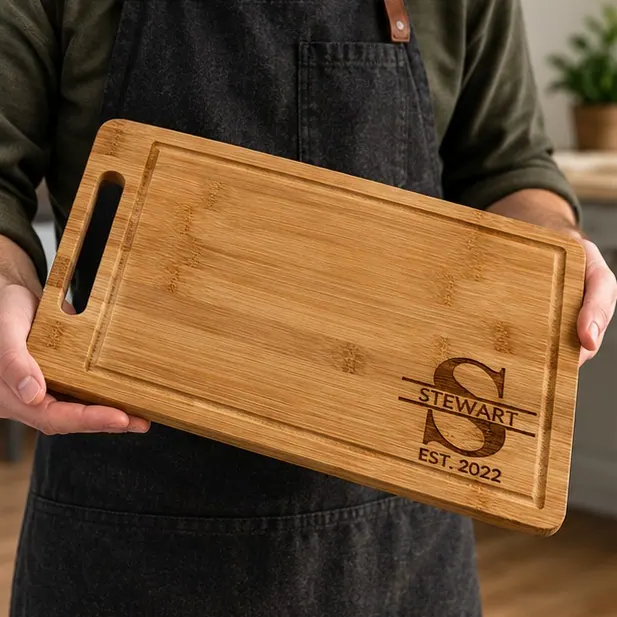
A timeless split layout with your initial, last name and optional EST year.
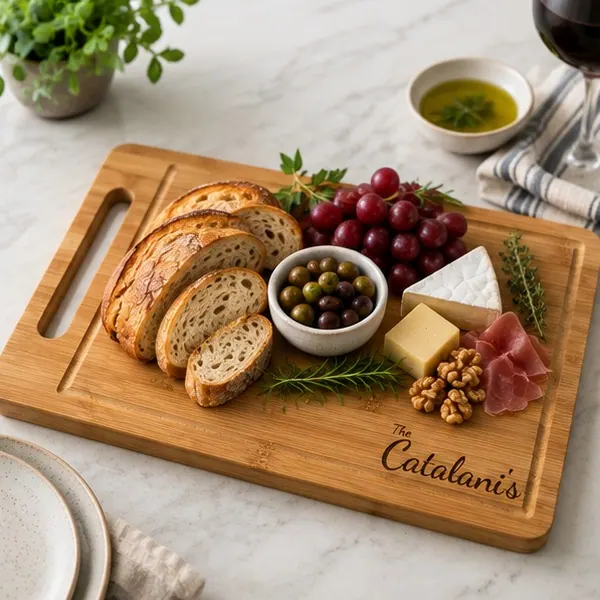
Soft script styling with an heirloom feel, especially strong for wedding gifting.
A butcher block is a thick end-grain or edge-grain surface that mostly stays put. A cutting board is a tool yo
Personalized means something gets made after you order, so it is not a same-day category. Here is the real tim
What to give parents who say they want nothing, how to split one gift between siblings, and what to engrave wh