
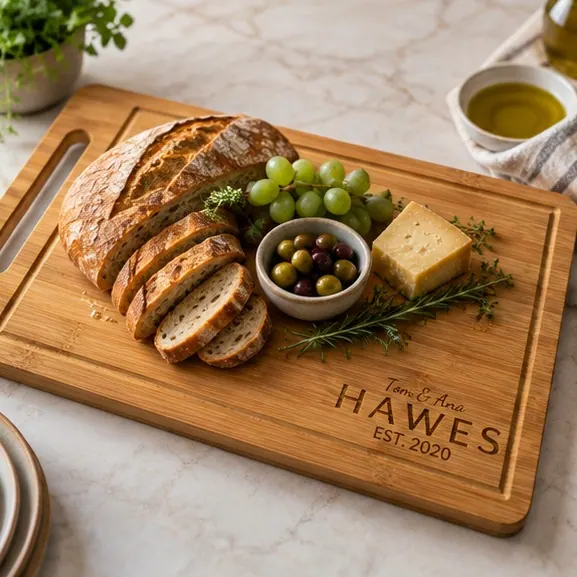
Classic Last Name
First names, last name and an optional EST year in the most versatile layout on the site.
$32.99–$39.99
Home › Guides › Cutting Board Engraving Ideas That Still Read Well in Ten Years
8 min readWhat to put on an engraved cutting board: names, dates, sayings and recipes, with the real character limits, the formats that fit, and what ages badly.
You have decided on the board. The harder question is what goes on it, and it is harder because the wood is charred rather than printed, so the text is not something you can redo later.
It is worth saying up front that the risk is smaller than it feels. Every order gets a confirmation showing exactly what will be engraved before anything is burned, and a board engraved wrong against what you confirmed is remade at no cost with nothing to send back. What you cannot undo is a decision that was correct in 2026 and awkward by 2036, which is what the rest of this is about.

Most engravings that hold up are a name and a date. That is not a lack of imagination; it is that a name is the one thing about a household that is both true and durable.
A surname alone. WHITFIELD. Clean, confident, and it fills the board properly because there is nothing competing with it.
A surname in the plural. The Whitfields. Reads as a family rather than a nameplate, and it includes children and partners without listing anyone.
A surname with the possessive. The Whitfield's in script. Warmer again, and the apostrophe is set for you in that layout rather than being something you type.
First names above a surname. Ana & Michael above WHITFIELD. The most information any of the layouts carries, and the right choice when the gift is about a household rather than a marriage.
A single initial as the design. The split monogram sets one large family letter with the surname threaded through it. The most formal of the options.
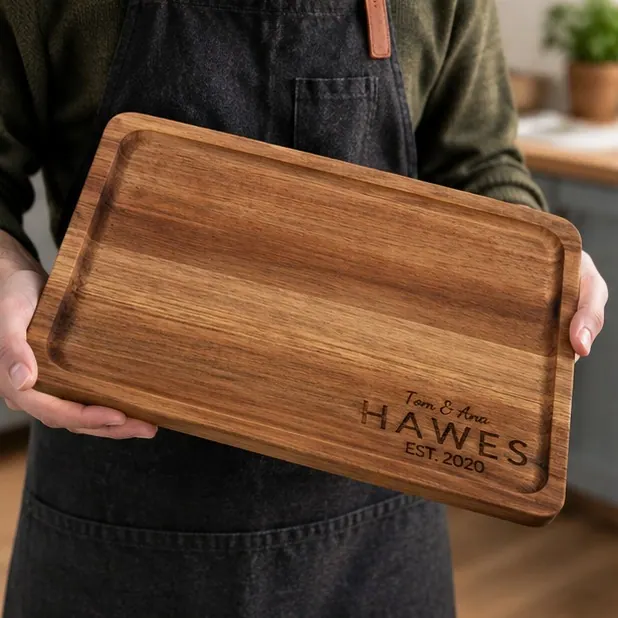
Three lines is the practical ceiling, and most good boards use two.
| Format | Example | Best for |
|---|---|---|
| Surname + year | WHITFIELD · EST 2026 | Weddings, new homes |
| First names + surname + year | Ana & Michael / WHITFIELD / EST 2026 | Households, housewarmings |
| Plural family name | The Whitfields | Families, Christmas, parents |
| Initial + surname + year | W / WHITFIELD / EST 2026 | Weddings, milestone anniversaries |
| Two first names, no surname | Ana & Michael | Couples keeping separate names |
| Name + short phrase | The Whitfields / Gather Here | Family kitchens, if the phrase earns it |
These get confused constantly, and they are not the same thing. One is a limit on the order form. The other is a judgment about how the lettering looks once it is on the wood.
| Field | The form accepts | Reads largest at |
|---|---|---|
| First names | 40 characters | About 20 |
| Last name | 24 characters | 10 or fewer |
| EST year | 4 characters | 4 |
The left-hand column is hard. Forty, twenty-four and four are what the fields take, and nothing longer can be submitted.
The right-hand column is taste, and it works the way you would expect: fewer words engrave larger. The engraving area is a fixed size, so the text scales down to fit it. A surname of ten characters or fewer carries the board. Past about fourteen the lettering gets visibly smaller, and at twenty it is smaller again. None of that is a failure. KUCHENBECKER engraves perfectly well at twelve characters; it simply does not shout the way HALL does. If the name is the name, use it, and put it in the last-name layout rather than a monogram, which has less room for it.
The live preview on each product page is the reliable way to settle this, because it renders your actual characters at their actual size.
Wedding. The shared surname with EST and the wedding year. If they are not taking a shared name, both first names with no surname. The full wedding treatment covers every awkward version of this.
Housewarming. The surname with the year they got the keys, not the year they married. First names above it if it is a family rather than a couple.
Anniversary. The wedding year, written as a date. Never a count of years.
Mother or grandmother. The family surname, usually with no year at all, because there is no event to point at.
Christmas. The plural family name, no year. A year ties the board to one particular December.
Closing or corporate gift. The client's surname and the year of the sale. Not your logo, and not your brokerage.
Four things, and they are the whole list of what goes wrong.
A count of years. A number that has to be re-earned every twelve months is the wrong thing to make permanent. A date is not. Personalized anniversary gifts sets the argument out in full, because that is the occasion where people reach for the count.
An address. Charming until they move, which most people eventually do.
A job, a title, or a company. All of these have a shelf life measured in years.
A font that belongs to a moment. Heavy distressed script dates faster than plain lettering does. Block capitals and clean serifs still look right in fifteen years.
The rule that covers all four: engrave identity, not circumstances. Names and dates do not move. Almost everything else does.
These work about a third of the time, and the successes and failures are easy to tell apart.
They work when the phrase belongs to that specific household. The thing one parent says every single time. The line the family has repeated since a holiday in 2014. Nobody else's board could carry it, which is exactly why it lands.
They fail when the phrase could belong to anyone. Bless this kitchen. Gather. Eat. Family is everything. World's Best Dad. All perfectly pleasant, all interchangeable, and all of them make the board look like something bought rather than something meant. A phrase that could be printed on ten thousand identical mugs does not become meaningful by being burned into wood.
Two practical constraints if you go this way. A phrase has to occupy one of the text fields, so it is bound by that field's character count, and beyond that keep it to roughly twenty-five characters for legibility, which is a judgment about size rather than a limit. And put it with a name rather than instead of one: a phrase alone is decor, a phrase with a name is theirs.
The strongest engraving available, and also the most demanding.
A grandmother's recipe card in her own hand, or a signature, or a short note, engraved onto a board, is the sort of gift people keep in a family for generations. It works because handwriting is unforgeable evidence of a specific person.
What it needs: a clean, high-contrast original. Dark ink on plain paper, photographed flat in good light, without a shadow across it. Faded pencil on a stained card can be worked with but the result is softer. Send what you have and ask before ordering. It is worth a conversation rather than a guess.
Every order gets a confirmation showing exactly what will be engraved, exactly as typed. Runs of ten or more get a proof sheet with every board on it, and runs over twenty-five get one engraved and posted out first, so you approve a real object rather than a picture.
Read the confirmation properly. It is the point at which a typo is free. If we engrave something different from what you confirmed, the board is remade at no cost and you keep the first one; if you confirmed a misspelling, that is the one case where the remake is not covered, which is why the confirmation exists.
A name and a date, in most cases: a surname with EST and the year of whatever the board marks. It is the format that works for the widest range of recipients because a name is the one thing about a household that is both true and durable. Everything else is a variation on it.
Ones that belong to that specific household, such as a phrase a particular parent always says, or a line the family has repeated for years. Generic kitchen phrases make a board look bought rather than meant. Keep any saying to around twenty-five characters for legibility and pair it with a name rather than using it alone.
The form accepts 40 characters of first names, 24 characters of last name and a 4 character year. Those are hard limits. Looking good is a separate matter: a surname of ten characters or fewer engraves largest, and anything past about fourteen gets visibly smaller because the text scales to fit a fixed area. Longer names still engrave cleanly.
Yes, and it is one of the best things you can put on a board. It needs a clean, high-contrast original: dark ink on plain paper, photographed flat in good light without a shadow. Faded pencil still works but comes out softer, so send the image and ask before ordering.
A family surname with EST and a year. It suits weddings, new homes and anniversaries alike, carries well at any length in the last-name layout, and is the format least likely to look dated in a decade. We do not publish order figures, so treat that as a design answer rather than a sales ranking.
Yes, and a year is usually better than a full date: it is cleaner, it fits the 4 character field, and it says the same thing. Use the year of the event the board marks, and avoid engraving a count of years, which stops being true twelve months later.
Every product page previews the actual text on the actual wood as you type, which settles most of these decisions faster than reasoning about them does. See all three layouts in bamboo and acacia, or start with monogram versus last name if the choice is between those two.
First names, last name and an optional EST year in the most versatile layout on the site.
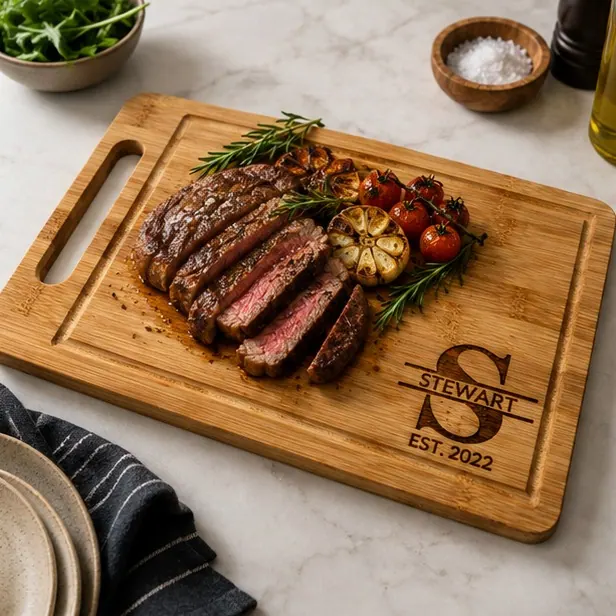
A timeless split layout with your initial, last name and optional EST year.
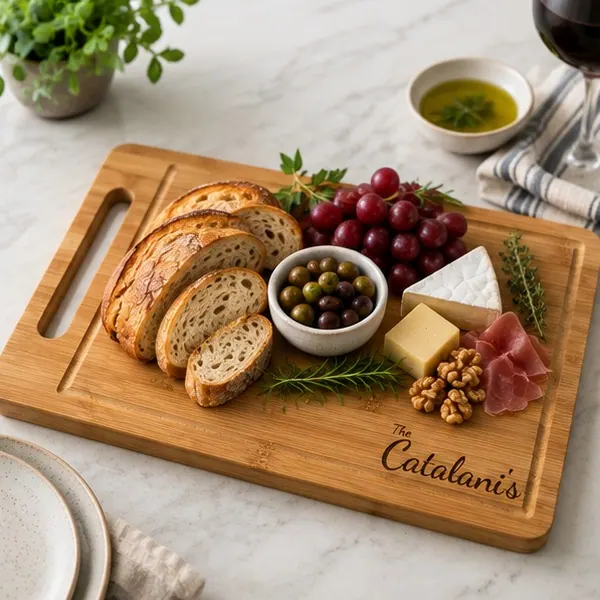
Soft script styling with an heirloom feel, especially strong for wedding gifting.
A butcher block is a thick end-grain or edge-grain surface that mostly stays put. A cutting board is a tool yo
Personalized means something gets made after you order, so it is not a same-day category. Here is the real tim
What to give parents who say they want nothing, how to split one gift between siblings, and what to engrave wh