
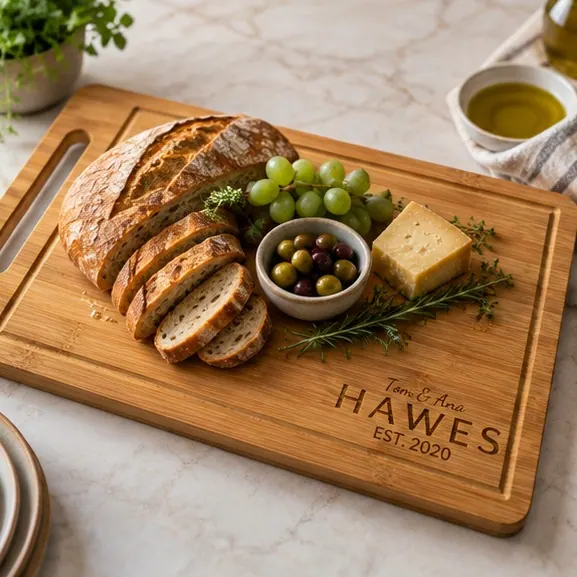
Classic Last Name
First names, last name and an optional EST year in the most versatile layout on the site.
$32.99–$39.99
Home › Guides › Monogram vs. Last Name Cutting Board: Which Should You Choose?
6 min readA split monogram leads with a large initial; a last-name board leads with the name. Which reads better depends on the surname, its first letter and the event.
Take the split monogram if the surname is short and begins with a letter that has some width to it: Hall, Brennan, Marsh, Webb. Take the classic last name if the surname is long or hyphenated, if the couple do not share one, or if first names need to be on the board. That is the decision. Everything below is why, and what to do with the cases in between.
Both are engraved boards with a family name on them. They read completely differently, and the choice comes down to the name itself far more often than to taste.
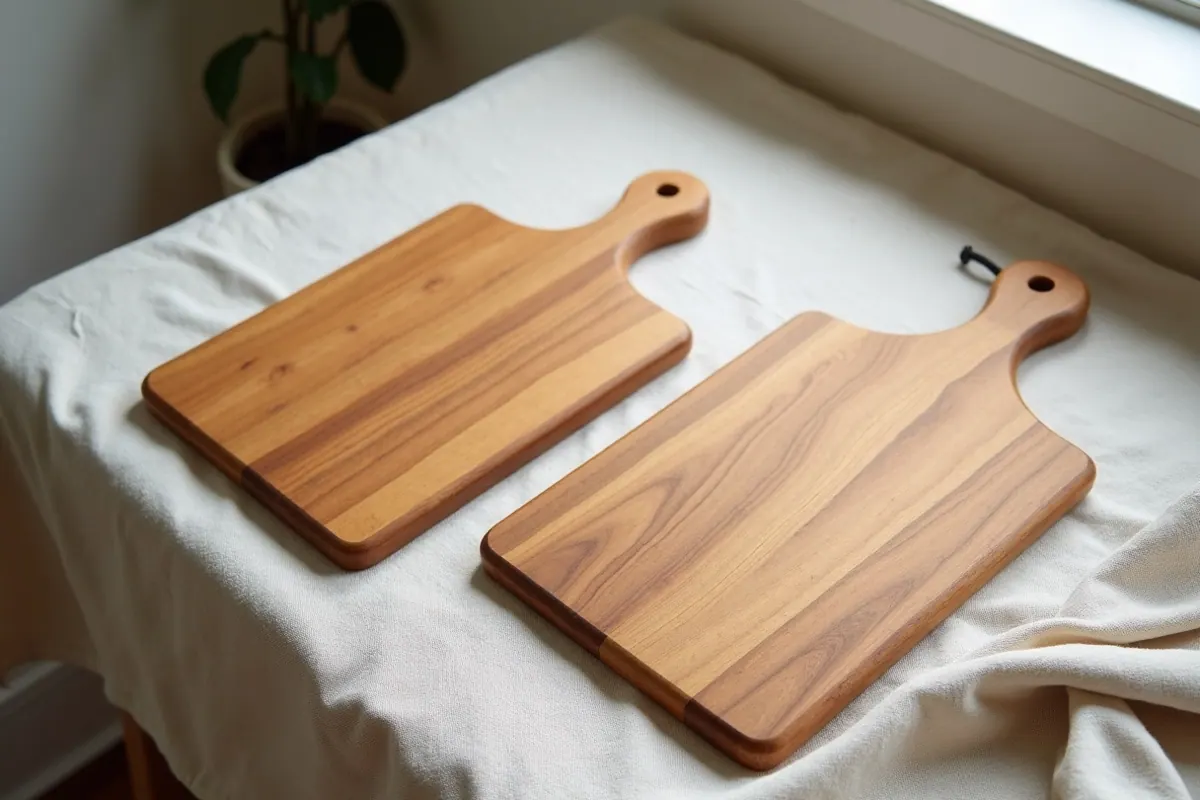
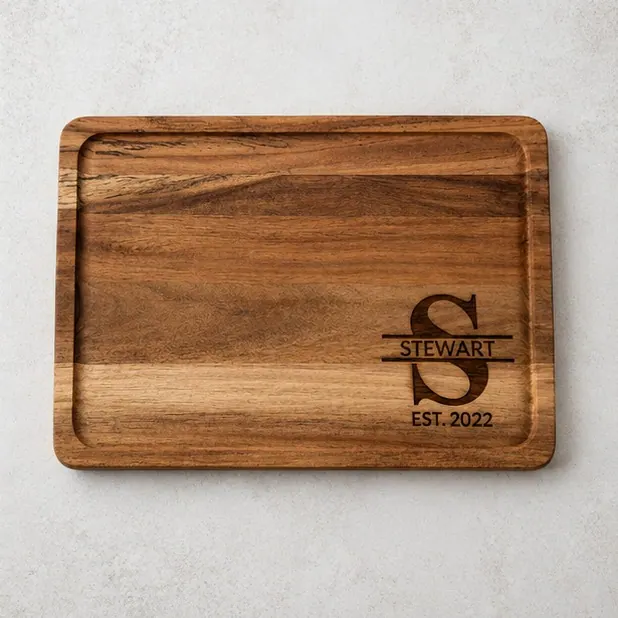
A split monogram sets a single large initial, the family's first letter, as the dominant element, with the surname running horizontally through the middle of it and an optional year below. The initial is the design; the name is threaded through it.
A last-name board leads with the surname in block capitals across the center, with first names above it and an EST year underneath. Nothing is decorative; the information is the design.
| Split monogram | Last name | |
|---|---|---|
| Leads with | A single initial | The surname |
| Surname field | 24 characters | 24 characters |
| Carries first names | Optional, less naturally | Yes, above the surname, 40 characters |
| Carries a year | Yes, 4 characters | Yes, 4 characters |
| Best surname length | Short to medium | Any, including long |
| Formality | Higher, more ceremonial | Warmer, more domestic |
| Largest element on the board | The initial | The surname itself |
| Needs a shared surname | Yes | No, it can carry both first names |
This is the deciding factor more often than anything else, so it is worth being precise about what the constraint actually is.
The form accepts 24 characters in the last-name field, and that is the same number on both layouts. No surname anyone is likely to own gets rejected. What changes between the two designs is not whether the name fits but how much room it gets, and that is a legibility judgment rather than a limit.
In the last-name layout the surname is the largest thing on the board and has a line to itself. In the monogram it runs through the middle of a large initial, so the same characters occupy a narrower band and come out smaller. The longer the name, the more that difference shows.
Short, strong surnames suit the monogram. Hall, Brennan, Pham, Okonkwo. The initial has weight and the name sits inside it cleanly.
Long surnames suit the last-name layout. Vasquez-Hall, Kuchenbecker, Raghunathan. All three are inside the 24 character limit and all three engrave. Threaded through a monogram they compress to the point of straining; given their own line in block capitals they are fine.
Surnames beginning with a visually weak letter, I, J or L, make less commanding monograms than B, C, H, K, M, R, S or W do. This sounds trivial and it is the difference between a monogram that owns the board and one that looks tentative.
If a name is borderline, the live preview on each product page settles it in about five seconds, because it renders the actual characters at the actual size.
Weddings lean monogram. It is the more ceremonial of the two, and it matches the visual language of the rest of the day: the stationery, the signage, the cake. See what to engrave on a wedding board for the text itself.
Housewarmings and family gifts lean last name. Warmer, more domestic, and it carries the first names, which matters when the gift is about a household rather than a marriage.
Anniversaries work either way, though the monogram's formality suits milestone years, a tenth or a twenty-fifth, better than it suits a third.
Closing gifts and corporate runs lean last name, mostly because it handles whatever surname turns up without you having to check whether the initial works.
If the two people do not share a surname, a split monogram has no initial to use. Picking one partner's initial makes the board about one of them, which is not the gift you meant to give.
In that situation the last-name layout handles it, with both first names above, no surname and a year below, or the script layout, which reads as a household rather than a surname.
There is a third option that sits between them. The script design sets "The" above a flowing family name, The Catelani's, with the possessive apostrophe set for you rather than typed.
It is the least formal of the three and the warmest. It works especially well for family gifts and for surnames that look stiff in block capitals. It is the wrong choice for a very formal wedding, where the monogram's ceremony fits better.
Every layout comes in both woods, and they behave differently. The monogram's fine internal lines hold their edges best on bamboo, where the surface is uniform. On acacia the burn is deeper and richer but grain movement competes with fine detail, which suits the bolder block lettering of the last-name design.
If you want the monogram specifically on acacia, choose a calm piece, and the wood comparison explains why that matters.
A board engraved with one large family initial as the main design, with the surname running horizontally through the center of that letter and usually a year beneath. The initial dominates the board and the name is threaded through it, which is what gives it a formal, ceremonial look.
The monogram, usually. It is the more formal of the two and it matches the visual language of the rest of a wedding. The exception is a couple not taking a shared surname, where a monogram has no single initial to use and a last-name or script layout works better.
The last-name field accepts 24 characters, and that is the same on both layouts, so length is almost never a reason a name cannot be used. What changes is how large it engraves. A long name given its own line in the last-name layout stays legible; the same name threaded through a monogram sits in a narrower space and comes out smaller.
Choose the last-name layout. A long surname threaded through a monogram compresses until it strains; given its own line in block capitals it stays legible and balanced. Script is the other good option for long names, because it compresses more gracefully than capitals do.
More than people expect. Letters with visual weight, B, C, H, K, M, R, S and W, make strong monograms. Narrow letters such as I, J and L produce a lighter initial that can look tentative on a wide board, in which case the last-name layout is the better choice.
It can, but less naturally than the last-name layout, which has a line designed for them and takes 40 characters there. If first names are important to the gift, for a housewarming or a family present, the last-name design carries them better.
Every product page previews your actual names on the board as you type, which settles this faster than any comparison can. A surname that looks marginal in the abstract usually looks obviously right or obviously wrong once it is on the wood.
Split monogram, classic last name, or all three in the shop. If you are choosing by kitchen style rather than by name, how to choose an engraved design approaches it from that direction, and cutting board engraving ideas covers what to actually put on whichever you pick.
First names, last name and an optional EST year in the most versatile layout on the site.
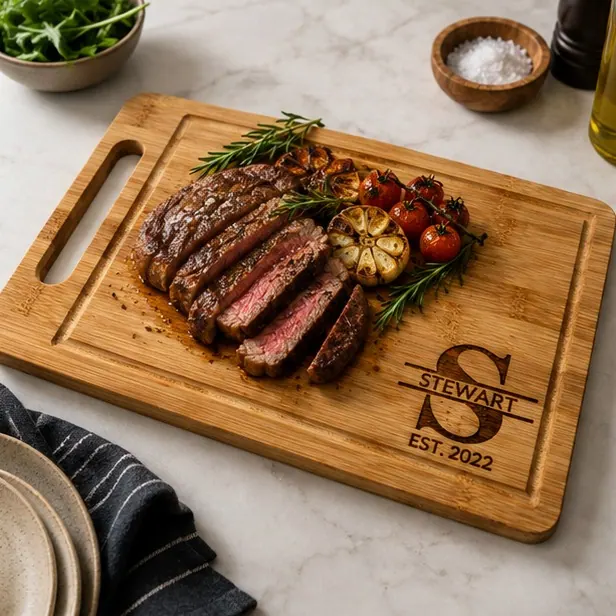
A timeless split layout with your initial, last name and optional EST year.
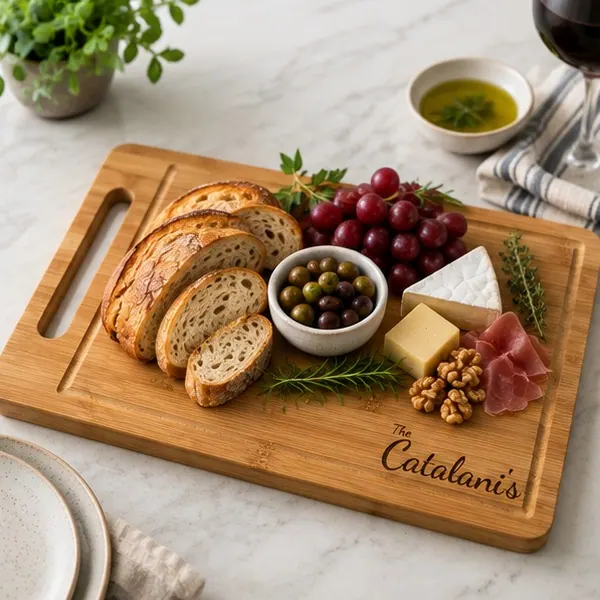
Soft script styling with an heirloom feel, especially strong for wedding gifting.
A butcher block is a thick end-grain or edge-grain surface that mostly stays put. A cutting board is a tool yo
Personalized means something gets made after you order, so it is not a same-day category. Here is the real tim
What to give parents who say they want nothing, how to split one gift between siblings, and what to engrave wh