
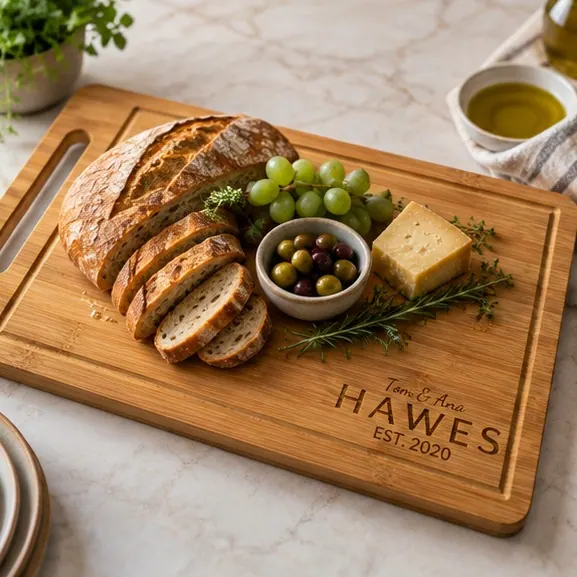
Classic Last Name
First names, last name and an optional EST year in the most versatile layout on the site.
$32.99–$39.99
Home › Guides › Personalized Gifts for Your Boss Without It Looking Like Currying Favor
10 min readWhether to give one at all, why a gift from the whole team is the safest structure, what it should cost, and the wording that keeps it from reading wrong.
Yes, but usually only as part of a group, only on an occasion that supplies its own reason, and for less money than you think. The object matters far less than the structure around it. The same board that reads as thoughtful when it comes from eleven people with a card reads as something else entirely when it comes from one person in a quiet moment with nobody else in the room.
Before any of the rest of it: many employers have a written policy covering gifts at work. Check yours and follow it. We make cutting boards, we have no view on what any company's policy says, and this guide is about the social read rather than the rules of your workplace.

The honest default is no, and the exceptions are specific.
Gifts between peers are easy because nothing travels up or down. A gift to a manager moves in one direction, and the person receiving it knows that as well as you do. Most managers who are any good are faintly uncomfortable receiving something from a person whose performance review they write, which is why the good ones deflect it toward the team.
So the question is not is this a nice gift. It is: does this gift have a reason that exists independently of me? A departure has one. Boss's Day has one, weak but real. A wedding, a birth or a new house at their end has one. A Tuesday in March does not.
If you cannot name the occasion in one sentence to a colleague without it sounding like an explanation, that is the answer.
Four things make a gift from a subordinate land badly, and none of them are about taste.
It is from you alone, and nothing prompted it. An unprompted solo gift asks the recipient to work out what it is for, and the most available answer is the uncomfortable one.
It cost too much. Money is the loudest signal in the transaction, and a gift that visibly cost a share of your own paycheck puts the recipient in your debt.
The timing sits next to a decision. Review season, a promotion round, the week before headcount is set. The gift is the same gift; the calendar changes what it says.
It is addressed to the job. A title, a department or your working relationship keeps the gift inside the hierarchy. A gift that steps outside work entirely does the opposite.
Which is why the group version works: it is not from you alone, it costs each person very little, it falls on a fixed date rather than a chosen one, and it can be about the person rather than the role.
A gift from the team is the safest structure available, and it is worth defaulting to it even when you would happily pay for the whole thing yourself.
It works because it removes the sender. Eleven people signing a card is not a relationship, it is a department, and no manager has to work out what a department wants from them. It also takes the decision off any one person, including you.
Running one where the recipient outranks everybody contributing has wrinkles a normal group gift does not. In order:
The mechanics of collecting money and getting one order placed are the same as any workplace collection, and the retirement gift guide works through those in detail: picking the gift before the amount, closing dates, and why five people with a shared document ends in two boards and a refund.
The ceiling is lower than most people guess, and the reason is proportion rather than generosity. A gift is read against the giver, so a large amount from somebody earning less than the recipient reads as effort that should not have been asked of them.
| Spend | How it reads coming from a subordinate | Verdict |
|---|---|---|
| Under $10 | A token, and sincere if it is specific to them | Fine from one person, any time |
| $10 to $25 | The normal band for one person to a manager | The safe solo range |
| $25 to $50 | A real object, clearly chosen | Right from a group; from one person only at a departure |
| $50 to $100 | A statement, and it will be read as one | Only from a whole team |
| Over $100 | No longer a gift in the ordinary sense | Avoid from a subordinate entirely |
Split across a team the middle band is easy. A $32.99 bamboo board or a $39.99 acacia one divided among ten people is a few dollars each, which is the right amount for a gift nobody was obliged to join. Delivered and boxed those come to $46.99 and $53.99, including the $6.00 gift box and $8.00 shipping on the first board. Treat that as a group number rather than a solo one, unless the occasion is a departure. The under-$50 guide lays out delivered totals the same way.
Boss's Day. Its entire function is to supply a date so that nobody has to justify the timing. Keep it modest and keep it from the team.
A departure. Either direction. When a manager leaves, the hierarchy is dissolving anyway, which makes this the one occasion where a larger gift is comfortable and a solo gift is fine. When you are the one leaving, it is unambiguous, because you are giving up any benefit from it on the way out.
A personal milestone. A wedding, a new baby, a house move. The best occasions of the lot, because the gift is aimed at their life rather than your working relationship, and nobody misreads a housewarming present.
A promotion. Congratulations rather than currying favor, as long as it is theirs and not something you are hoping follows from it.
That leaves December, the awkward one. A holiday gift up the chain is common and is where the group structure earns its keep most: one gift from the team, a card everybody signs, and no individual gifts alongside it.
The field limits settle this before taste does. The last name field accepts 24 characters and the first names field 40. That is one family name, not eleven signatures, and even if a roster fit it would produce an object that is about the office rather than about the person.
So: the surname on the board, everybody in the card. The printed card takes 200 characters, which is enough for the whole team and one sentence that means something.
Leave off the job title, which dates faster than anything else you could burn into wood, and the company name, which converts a gift into merchandise: the client gift guide makes that argument in full. Leave off dates tied to the job, since a start year on a household object is a work anniversary sitting in somebody's kitchen, and leave off in-jokes, which are funny in the room on the day and permanent everywhere else.
For which of the three layouts suits a name, monogram versus last name compares them by surname length and first letter, which is the thing that actually decides it.
This is the move that removes almost all of the awkwardness, and it is underused.
Address the gift to where they live rather than to who they are at work. A board carrying the family name in the plural is not a gift to a manager. It is a gift to a house, used by a partner and whoever else lives there, most often by somebody who has never met you.
Everything uncomfortable about the transaction drops away at that point. There is no flattery in a kitchen object with a family name on it, because the name is the household's rather than the manager's professional identity, and the hierarchy does not exist in their kitchen.
It also solves the taste problem. You may not know what a manager likes, but you know they eat, and a board sits out on a counter rather than needing to be displayed.
Confirm the spelling with somebody who knows the family rather than taking it from an internal directory, which carries the legal spelling that households do not always use. If there is any chance the surname at home differs from the one at work, use first names instead. Every order comes back with a confirmation showing the exact text before anything is engraved, and anything engraved differently from what you confirmed is remade at no cost.
A few details that matter more for a work gift than a normal one.
Usually only as part of a group, and only when an occasion supplies the reason: Boss's Day, a departure, a promotion, or a personal milestone like a wedding or a new house. An unprompted gift from one person with no occasion attached is the version that gets misread.
Less than you would spend on a peer. From one person, roughly $10 to $25 is the comfortable band. Above about $50 from a single subordinate it reads as a statement, so a larger object should be split across the team, where a $32.99 board divided ten ways is a few dollars each.
Nearly always. A group gift has no single sender, so no personal debt is attached to it and nobody has to decide alone whether giving was appropriate. It also keeps the per-person cost low enough that joining in is easy and opting out goes unnoticed.
Put the surname on the object and the team in the card. The last name field holds 24 characters, which is one name rather than a list, and the printed card holds 200 characters, enough for the names and one real sentence. Leave job titles, the company name and dates tied to the job off the object.
It is, and that is essentially what the date is for: it supplies a reason so nobody has to invent one or choose a moment. Keep it modest and keep it from the team rather than from an individual, and it reads exactly as intended.
This is the least complicated version of the gift, because you are giving up any benefit from it on the way out. A solo gift is fine here, and a slightly larger one is too. Hand it over on your last day rather than mailing it afterwards.
Yes, and it is the cleanest way to do it. A household object carrying the family name is not addressed to their professional identity, so none of the hierarchy travels with it. Confirm the spelling with somebody who knows the family rather than from a work directory, and ship it to the house.
All three layouts are in the shop in bamboo and acacia with a live preview, so you can type the family name and see it before anyone commits. If the occasion is a departure rather than a normal year, the retirement guide covers what changes when the gift marks the end of a working identity.
First names, last name and an optional EST year in the most versatile layout on the site.
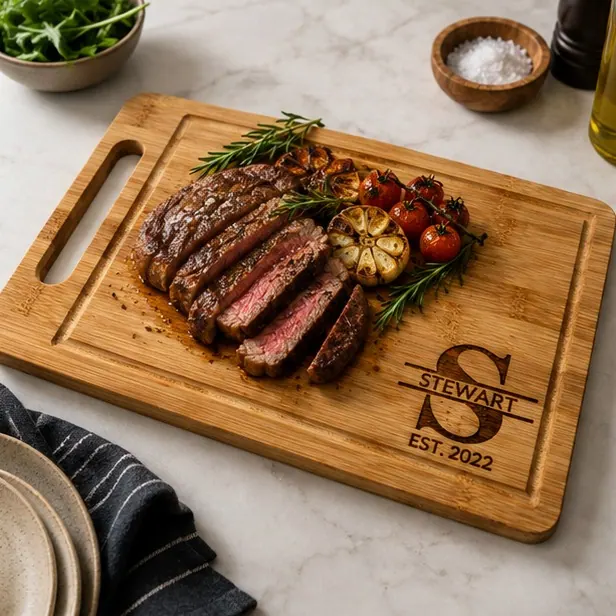
A timeless split layout with your initial, last name and optional EST year.
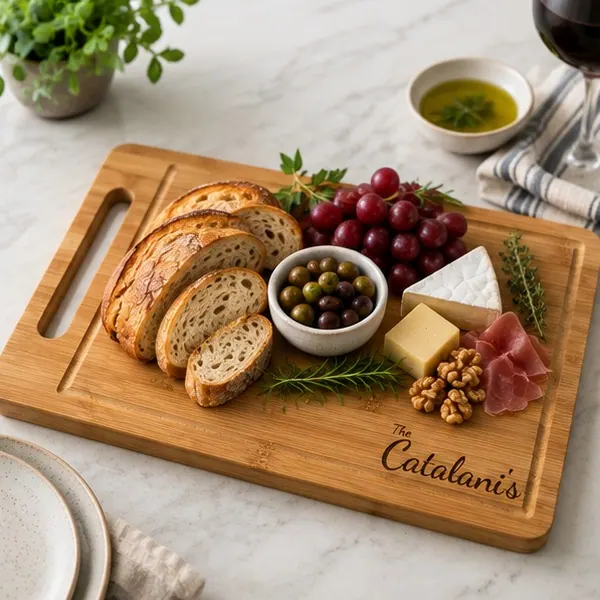
Soft script styling with an heirloom feel, especially strong for wedding gifting.
A butcher block is a thick end-grain or edge-grain surface that mostly stays put. A cutting board is a tool yo
Personalized means something gets made after you order, so it is not a same-day category. Here is the real tim
What to give parents who say they want nothing, how to split one gift between siblings, and what to engrave wh