
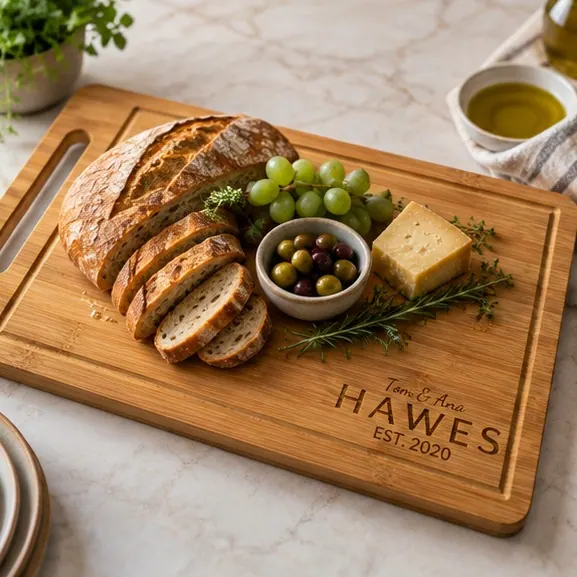
Classic Last Name
First names, last name and an optional EST year in the most versatile layout on the site.
$32.99–$39.99
Home › Guides › Personalized Corporate Gifts for Clients That Do Not Get Thrown Away
9 min readWhy branded merchandise fails and personalized gifts do not: what to spend per client, where a logo belongs, the order minimum, and how a name run is produced.
Most corporate gifting budgets are spent on objects that are in a drawer by February. It is not a spending problem; it is a category problem.
The fix is a single change of subject: make the gift about the client rather than about you.
There is one test for a client gift, and it is not a question about taste or budget. It is a question about February: will this still be in their house in a year?
That is the entire measure, because a gift that has been discarded does not remind anyone of anything. Everything else, the unboxing and the packaging and the card stock, is upstream of it and worth nothing on its own.
Run the usual options through it honestly. A branded fleece: worn to wash the car, if at all. A hamper: gone in two weeks. A bottle: gone in an evening. A desk item with a logo on it: in a drawer by the time the desk is next tidied. A branded notebook: used for six weeks, then replaced by the phone.
Very little in the standard corporate catalogue survives twelve months, and that is why so much of the budget evaporates.
This is the decision that separates a gift from merchandise, and it is worth being blunt about.
An object with your logo on it is advertising that the recipient is expected to store, display and dust. Everyone understands this instinctively, which is why branded items are received politely and kept briefly.
An object with the recipient's own name on it is a gift. It carries no obligation and no message, so it gets kept on its own merits, and the person who sent it is remembered anyway, because the memory is attached to the object rather than printed on it.
The practical version:
For what goes on the object instead, cutting board engraving ideas covers the formats that fit and the ones that date, with a job title or a company name at the top of the list of things not to burn into wood.
Realtors arrive at the same conclusion for the same reason, and the closing gift guide works through that version of it in detail.
| Spend | What it buys | Honest verdict |
|---|---|---|
| Under $15 | Branded merchandise | Advertising, not a gift |
| $15–$30 | Consumables, small desk items | Pleasant, gone by spring |
| $30–$60 | A personalized object that lasts | The sweet spot |
| $60–$120 | A larger set, or a premium single piece | Right for high-value accounts |
| $120+ | Mostly packaging and presentation | Diminishing returns quickly |
Above about $60 the additional money increasingly goes into boxes, ribbons and a courier, rather than into anything the client still has in a year. The curve flattens harder than most gifting proposals admit.
December is the worst possible time to send a client gift, because it arrives alongside everyone else's.
Better moments, all of them quieter and all of them more memorable:
Employee gifting follows the same logic: work anniversaries and retirements land far better than a December run does, and a name engraved on something is the difference between a memento and a leaving card.
Engraving is the same work whether it is one board or fifty, so the pricing reflects that rather than charging per name.
| Quantity | Bamboo, each | Acacia, each | Discount |
|---|---|---|---|
| 10–24 boards | $29.69 | $35.99 | 10% off |
| 25–49 boards | $28.04 | $33.99 | 15% off |
| 50+ boards | $26.39 | $31.99 | 20% off |
The whole run travels together on one consignment, at $8.00 for the first board and $4.00 for each one after, rather than a parcel per board. Woods and layouts can be mixed freely; the discount is on the total count, not on any one design.
Each board carries a different name at no extra cost. Engraving is set per board either way, so variable text is not an upcharge here.
Three things bulk buyers ask before anything else.
The minimum is 10 boards. At the 10 to 24 tier that is $296.90 in bamboo or $359.90 in acacia, before shipping. Shipping on ten boards in one consignment is $44.00, so the realistic floor for a first corporate run is about $341 in bamboo or about $404 in acacia. There is no minimum dollar value separate from the board count.
Payment. Orders on the site are paid by card at checkout, processed by Stripe. Bulk runs start with a written quote rather than a cart, so if your accounts department needs to pay against an invoice or a purchase order, raise it in the quote request and you will get a straight answer with the price. We are not going to publish terms here that your procurement team would then have to unpick.
Reordering. There is no account to set up and no contract to renew. Send the new name list to the same address, and the run is priced on its own count, so a repeat run of ten gets the same 10% tier as the first one did. Quantity does not accumulate across orders. If you are running an annual program, ordering one larger batch beats two small ones, both on the discount tier and on the single-consignment shipping.
The logistics are where corporate gifting usually goes wrong, so this is worth setting out plainly.
Send the list however it exists. A spreadsheet, an email, a photograph of a notepad. It does not need formatting.
You get a proof sheet before anything is burned. Every board, spelled exactly as it will be engraved. This is the moment to catch the two or three names that are wrong in your own CRM, which on a list of fifty there always are.
For runs over twenty-five, one board is engraved and posted to you first, so you sign off on a real object rather than a rendering.
Get the date in writing. A single board is 3 working days in production; a run of fifty plainly is not, and the honest answer is that the schedule depends on what else is on the bench that week. The quote you get back names a date. Treat that date as the commitment, not any estimate in a guide, and give the workshop your own deadline up front so it can be accepted or declined before you commit.
Individually boxed or packed together, your choice: boxed if they are being handed out one at a time, bulk-packed if they are going to one address for distribution.
Ask your accountant, not a gift supplier. We make cutting boards and we are not qualified to advise on your tax position, which depends on facts we do not have.
The only thing worth knowing before that conversation: the US deduction for business gifts is capped per recipient per year, and the cap is low enough that most gifts worth giving exceed it. That is a reason to check the current figure with someone qualified, not a reason to spend less.
Something personalized to the client that has a use in their home rather than their office, and that survives a year, which is the only real test of a client gift. Objects carrying the recipient's own name outperform branded merchandise consistently, because a logo makes the item advertising that the client is expected to store.
Better not. A logo on the object turns a gift into merchandise, and recipients read it that way. Put your name on the card, which is discarded within a week anyway, and the recipient's name on the object, which is not. If a logo is unavoidable, keep it small and on the reverse.
Between $30 and $60 buys something that is still in the client's house a year later, which is the point at which a gift has done its job. Above roughly $60 the extra spend increasingly goes into packaging and delivery rather than into the object itself.
Things they use at home that carry their own name. Kitchen and household items outperform desk items heavily, because a desk gets tidied and a kitchen does not, and a personalized object is the one thing in a gift cupboard that cannot be passed on to someone else.
Yes, and at no extra cost, because each board is engraved to order regardless of how many are in the run. Send the list in whatever form it exists and you get a proof sheet showing every board, spelled as it will be burned, before anything is engraved.
Ten boards. At the 10 to 24 tier that is $296.90 in bamboo or $359.90 in acacia, plus $44.00 shipping for the whole run in one consignment. Woods and layouts can be mixed across the order and the discount is worked out on the total count.
Ask for a date in writing when you ask for the quote, and give your own deadline at the same time. A single board is 3 working days in production plus about 6 in transit; a run of ten or fifty is a scheduling question rather than a fixed figure, and it is a one-person workshop, so the answer comes back with the price. For December gifting, order in early November, or better, move the run to a quieter month when it will not arrive alongside everyone else's.
Bulk and corporate pricing starts at ten boards, and the inquiry form goes straight to the person who makes them: a written answer, usually the same day, with no call booking. If you want to see the designs first, the shop has all three with a live preview of any name you type.
First names, last name and an optional EST year in the most versatile layout on the site.
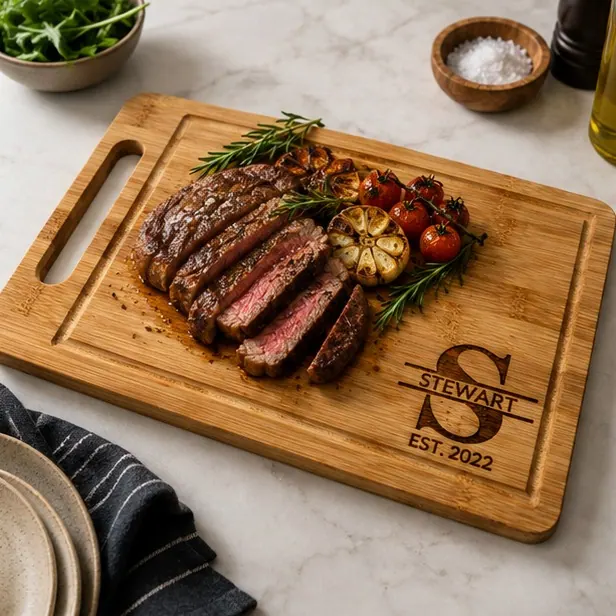
A timeless split layout with your initial, last name and optional EST year.
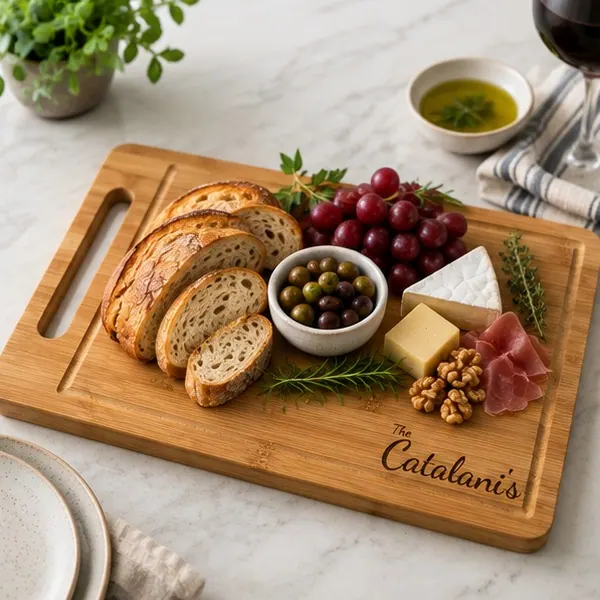
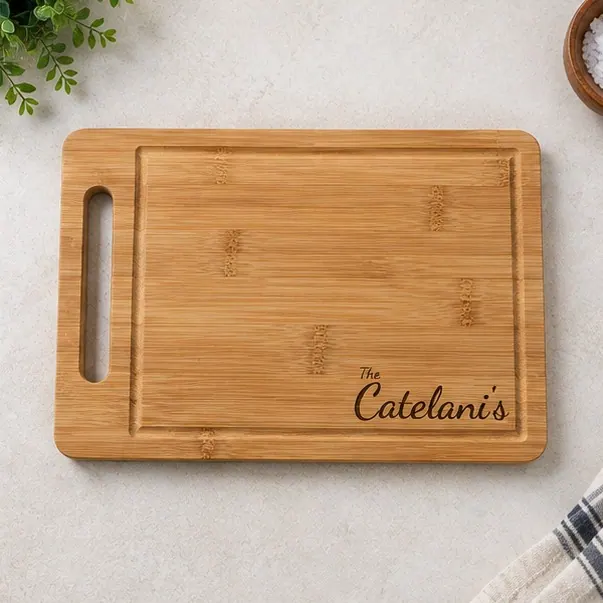
Soft script styling with an heirloom feel, especially strong for wedding gifting.
A butcher block is a thick end-grain or edge-grain surface that mostly stays put. A cutting board is a tool yo
Personalized means something gets made after you order, so it is not a same-day category. Here is the real tim
What to give parents who say they want nothing, how to split one gift between siblings, and what to engrave wh