
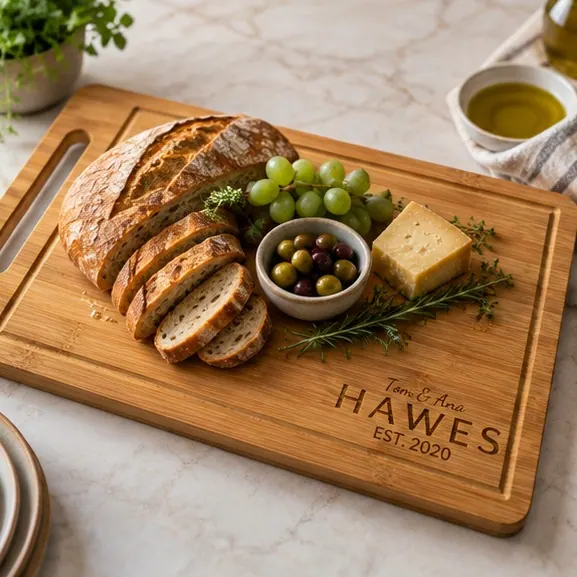
Classic Last Name
First names, last name and an optional EST year in the most versatile layout on the site.
$32.99–$39.99
Home › Guides › Realtor Closing Gift Ideas That Feel Premium
7 min readWhat makes a closing gift read as expensive when it is not, what to spend by sale price, and why the percentage-of-commission rules do not add up.
"Premium" is not a price band. It is a set of signals, and most of them are cheap to get right and easy to get wrong.
An agent working $1M+ listings needs a closing gift that does not embarrass the transaction. That does not mean spending $300. It means understanding what people actually read as expensive.

Material honesty. Real wood, real metal, real leather. Not a veneer, not a print made to look like grain. People detect this instantly and slightly resent it when they do. This is the first signal because it is the one that cannot be faked with budget.
Restraint. More decoration reads as less confidence. One name, one year, and a lot of empty space around them looks expensive. A board covered in scrollwork, a quote and a date looks like a craft-fair item.
Presentation. The same object arriving in a kraft box with a card you wrote yourself, versus in a plastic sleeve, is not the same gift. This costs almost nothing and changes the impression completely.
A note on weight, since every premium gifting guide leads with it. It is not a lever available here: both boards are recorded at 15oz bare and the packaged weight is the same for both woods, so anyone claiming the hardwood feels substantially heavier in the hand is guessing. What does differ is the face: acacia is 0.6in thick against bamboo's 0.5in, and acacia's grain is irregular where bamboo's is uniform. Argue those and you are on solid ground.
| Sale price | Sensible gift range |
|---|---|
| Around $400,000, near a median US sale | $50 to $100 |
| $750,000 | $100 to $150 |
| $1,500,000 | $150 to $250 |
| $3,000,000 and above | $250 to $400 |
There is no percentage rule in that table, deliberately. You will see "about a tenth of a percent" quoted for this, and it does not survive arithmetic in either direction. A tenth of a percent of a $400,000 sale price is $400, which nobody spends on a closing gift. A tenth of a percent of the agent's side of the commission on that sale is closer to $10, which is not a gift. The percentages in circulation are off by an order of magnitude one way or the other, and the honest version is a judgment about what reads as proportionate at each level rather than a formula.
The band at the median matches what the referral case for closing gifts argues: $50 to $100 is where most agents land, and the amount rises with the sale far more slowly than the commission does.
At the top of the table you are into commissioned work: a custom piece, a serious bottle with provenance, art. At the bottom and middle, which is most sales, a well-made personalized object in a real material does the job completely.
What does not work at any level: spending more on a fundamentally generic item. A $200 gift basket is still a gift basket.
For a premium closing gift specifically, take acacia, and the reason is grain rather than heft.
Acacia is a hardwood with irregular, visible grain movement, so no two boards look quite the same and none of them looks manufactured. Bamboo is laminated and uniform, which is a genuine virtue in a board that gets worked on daily and a mild liability in an object chosen to look one of a kind. On dimensions, acacia is 12in x 8in x 0.6in with a flat face; bamboo is 12in x 7.8in x 0.5in with an integrated handle, which is the more useful board and the less ceremonial one.
Bamboo is not a composite substitute and it is not promotional merchandise. It is the board most buyers here should choose. It is simply not the one to choose when the whole job of the object is to look considered on a kitchen island.
On a gift where the impression matters more than the $7.00 difference, take the acacia. The full wood comparison covers where bamboo is genuinely the better choice, which is most other situations.
Less. Always less.
> CATELANI > EST 2026
Surname and year. No first names if the surname is strong, no address, and no brokerage mark on the face.
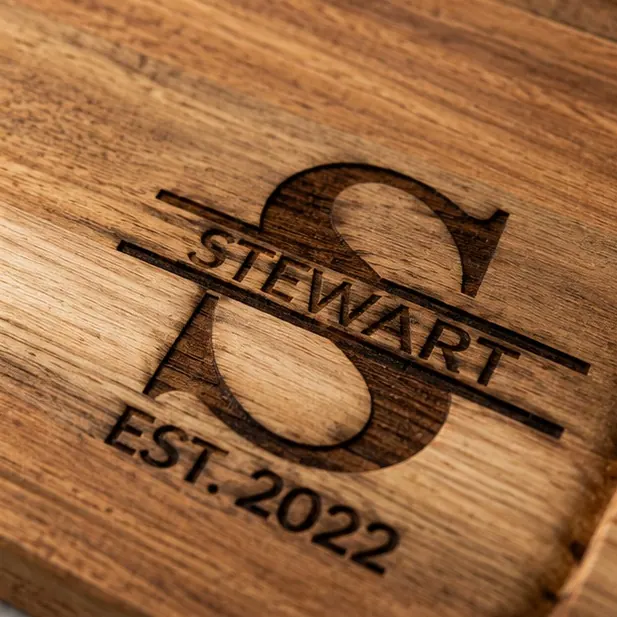
On your own branding, the policy here is the same one set out in personalized corporate gifts for clients, which covers the reasoning in full: a logo is available and discouraged. If your brokerage requires a mark, it goes small and on the reverse, where it reads as a maker's note rather than as advertising. On the face of a premium gift it converts the object into marketing material, and marketing material is not premium at any price. The split monogram is the most formal of the three layouts and photographs best, which matters if the client is the sort to post the closing.
For a very high-value sale where you want to spend more, the answer is not more engraving. It is a larger or finer object carrying the same restrained engraving.
Whatever you give, give it in something. A kraft box, a card written by hand rather than printed. The gap between "an object handed over" and "an object presented" is enormous relative to what it costs to close.
Gift boxing is available on every board here for $6.00, with no prices anywhere in the parcel, which also lets you have it sent directly to the client if you cannot be there.
Material honesty, restraint and presentation, in that order. A real hardwood object with one name on it and space around it, arriving in a proper box, reads as expensive at $40. The same money spent on a decorated object in a fake material reads as cheap at twice the price. Weight is the signal every gift guide leads with, and it is not usable here: both woods are recorded at the same weight, so the honest difference is grain and a 0.6in face against 0.5in.
On a $1.5M sale, $150 to $250 is proportionate; above $3M, $250 to $400, at which point you are into commissioned work. Ignore the percentage-of-commission rules that circulate for this question: a tenth of a percent of a $400,000 sale price is $400 and a tenth of a percent of the commission on it is about $10, so the rule is wrong in both readings. The amount should rise with the sale price, but far more slowly than the commission does.
Acacia, for this purpose, on grain rather than weight. Acacia's grain is irregular and visible, so the board looks like a piece of wood rather than a product, and its face is 0.6in against bamboo's 0.5in. The two weigh the same, so ignore anyone who tells you the hardwood feels heavier. Bamboo is the better working board and slightly cheaper, and it is the right choice almost everywhere except a gift whose job is to look considered.
No. Better made, not bigger. A larger cheap object does not read as more premium, it reads as more cheap object. Material and restraint do the work that size does not, and a board large enough to be awkward to lift stops being used, which is the only way a closing gift fails permanently.
Your brokerage, your logo, your phone number, a slogan, or a full date. Any of those turns the gift into marketing material, and marketing material is not premium at any price. One name and one year.
More than almost anything else you can control for the money. The same object in a kraft box with a card you wrote yourself versus in a poly mailer is not experienced as the same gift, and the difference costs a few dollars.
If you close enough to need these regularly, bulk pricing starts at ten boards and each one carries a different family name. That combination of a consistent, recognizable gift that is nonetheless personal to each client is what turns a closing gift into something clients mention to their friends.
For the broader comparison of gift types and what gets kept, see closing gifts for clients.
First names, last name and an optional EST year in the most versatile layout on the site.
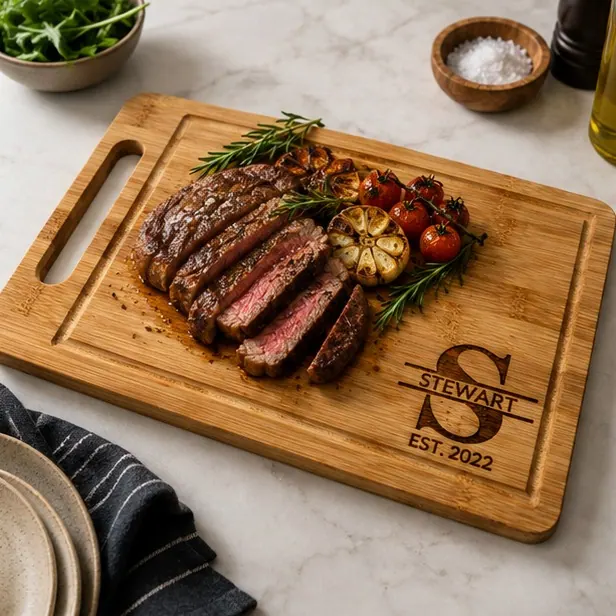
A timeless split layout with your initial, last name and optional EST year.
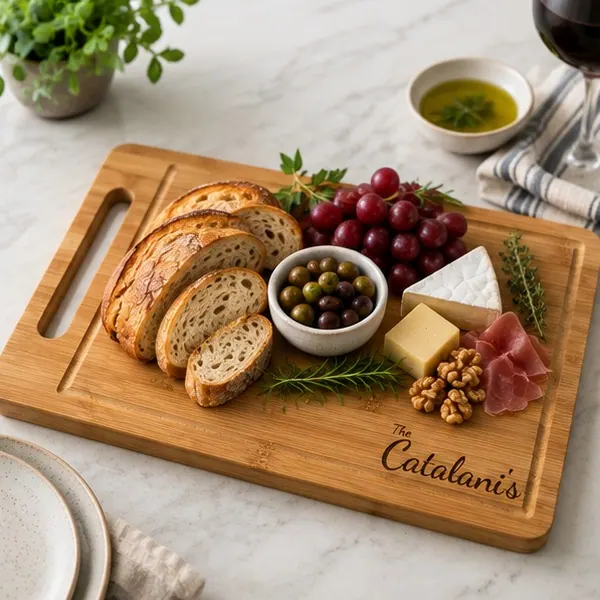
Soft script styling with an heirloom feel, especially strong for wedding gifting.
A butcher block is a thick end-grain or edge-grain surface that mostly stays put. A cutting board is a tool yo
Personalized means something gets made after you order, so it is not a same-day category. Here is the real tim
What to give parents who say they want nothing, how to split one gift between siblings, and what to engrave wh