
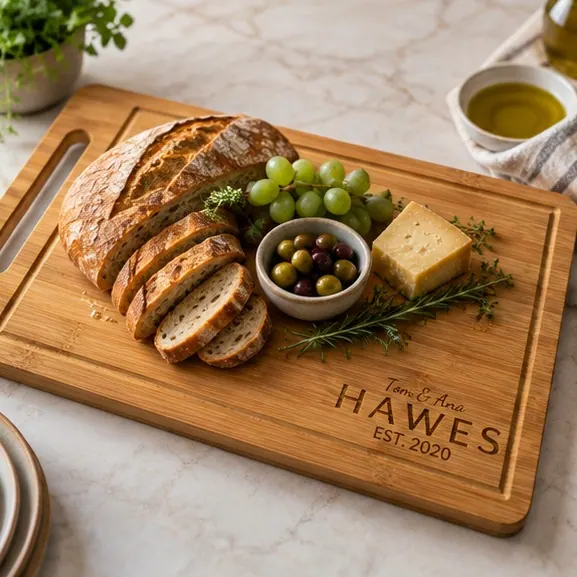
Classic Last Name
First names, last name and an optional EST year in the most versatile layout on the site.
$32.99–$39.99
Home › Guides › Why Realtors Love Personalized Housewarming Gifts
8 min readThe referral case for closing gifts: why personalization beats branding, which gifts survive to the referral window, and the gift-value rules to check locally.
Agents do not give closing gifts out of sentiment. They give them because referrals and repeat business matter to a practice, and both require a client to remember you at an unpredictable moment years later.
That is a marketing problem with an unusually clean solution.

Ask any agent past their first few years where their deals originate and you get some version of the same answer: past clients and people those clients sent. Cold leads are expensive, portal leads are competitive and low-converting, and advertising decays the moment you stop paying.
A past client is the opposite: free, pre-qualified, and pre-sold on you specifically.
The catch is timing. Your client will move again eventually, and it will probably be later than you expect. Their friend will mention needing an agent at some unknowable point before that. Neither event is one you can schedule, and any number you have been quoted for how long people stay put is worth checking against current data rather than repeating.
So the entire problem reduces to: be present in that house, in a good way, for years.
Almost every popular closing gift.
Wine is drunk. Candles burn. Gift baskets are eaten within two weeks. Each produces a genuine moment of goodwill and then ceases to exist. By the time a referral opportunity arises, there is no trace left except the client's own memory, which is exactly the thing you cannot rely on.
| Gift | Still exists in two years? | Stays visible? | Typical cost |
|---|---|---|---|
| Wine or spirits | No | No | $25 to $80 |
| Candle | No | While it lasts, then no | $20 to $50 |
| Gift basket or hamper | No | No | $50 to $120 |
| Gift card | No | No | Whatever you load |
| Branded mug or tumbler | Yes | No, it goes in a cupboard | $15 to $30 |
| Generic kitchen item | Yes | In a drawer | $40 to $120 |
| Framed art or decor | Yes | Only if you guessed the taste | $60 to $200 |
| Board engraved with the family name | Yes | Yes, on the counter | $32.99 to $39.99 here |
Read the second column first. It is the one that decides whether the gift is still working at the moment you need it to.
This is not an argument that those gifts are bad. It is an argument that they are doing something different: they are saying thank you, not building recall.
Here is the counter-intuitive part, and the one agents get wrong most often.
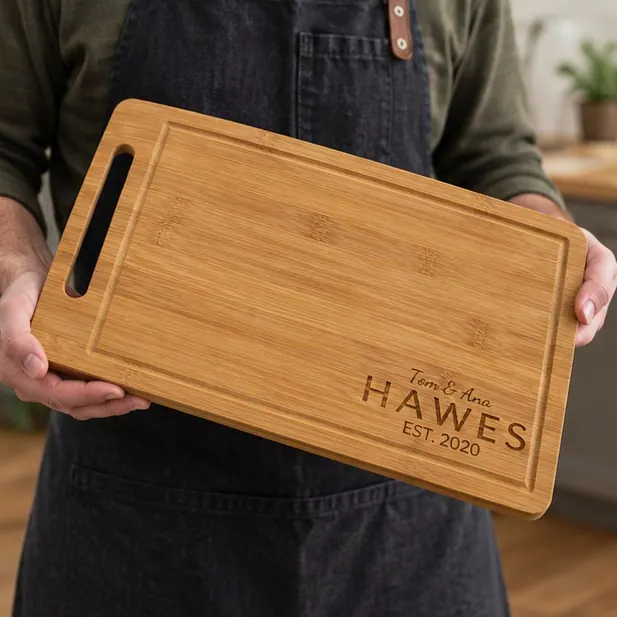
The instinct is to brand the gift: your logo, your name, your contact details, on the reasoning that this is how you stay top of mind. It does the opposite, because a branded object is read as advertising and advertising gets stored rather than displayed.
An object carrying the family's own name is understood as theirs. It goes on the counter, on the wall, on the table when guests come. And every one of those guests sees a good-looking object with their friends' name on it, asks about it, and is told where it came from.
You lose the logo. You gain the display, and the display is the entire mechanism. Personalized corporate gifts for clients sets out the argument in full, including where a logo is still available and why it is discouraged rather than refused.
A personalized board costs roughly $40. An agent's side of the commission on a single sale is a large multiple of that.
That asymmetry is the whole argument, and it is worth stating without inflating it. One additional referral that converts, once, across a book of past clients, pays for a great many gifts. What it does not do is return a precise multiple that anyone can quote you: the return depends on your conversion rate, your split, your price point and how many of the gifts do nothing at all, and none of those are knowable in advance. Treat any guide offering you a figure with suspicion, including the ones that offer a flattering one.
The defensible version: the gift is cheap relative to the thing it is trying to influence, it has to work only occasionally to be worth doing, and that is enough of a reason. It is also why agents who do this at volume tend to standardize on one recognizable gift rather than improvising each time.
This is the part gift guides skip, and it is the part with actual consequences. We make cutting boards; we cannot tell you what you are allowed to give, and anyone selling you one who claims otherwise is guessing. Three things to establish locally, once, before a closing gift becomes a habit:
Your brokerage's own policy. Many set a cap on client gift value, require gifts to run through the brokerage, or restrict what can carry brokerage branding. This is the fastest of the three to answer and the one most often skipped. Ask your broker in writing.
Your state's rules. Real estate licensing rules vary by state on gifts, rebates and inducements, and the rules generally distinguish a thank-you to your own client after closing from anything that looks like payment for a referral, particularly to an unlicensed person. Your state commission publishes this. Read it rather than inferring it from what other agents do.
Whether it has to be disclosed. If the gift is paid for by you personally out of already-earned commission, that is a different question from a gift paid by a lender, a title company, a home warranty provider or anyone else in the transaction. Anything of value flowing from a settlement service provider is a regulated area, and it is a question for your broker or your attorney, not for us.
None of that is a reason not to give a closing gift. It is a reason to spend fifteen minutes establishing the boundaries before you order ten boards a year for the next decade.
It is worth being honest about the limits, because gift companies are not.
A closing gift does not make a bad experience good. A client who felt poorly served will not refer you because you sent a board. The gift amplifies a relationship that already exists; it does not create one.
Nor does it make someone refer you who otherwise would not want to. What it does is make them think of you at the moment they otherwise would not have. That is a smaller claim than most marketing makes, and it is the true one.
The ones who do this well treat it as a system rather than a decision each time:
That last point matters more than the object. The gift is the artifact; the moment is the memory.
Because referrals and repeat business are where most of an agent's income comes from, and both depend on a client remembering them years after the sale. A gift that stays visible in the home keeps the agent present at the unpredictable moment a friend mentions moving.
They do not create goodwill that was not already there, and a client who felt badly served will not refer you because of a gift. What a well-chosen gift does is keep you in mind at the moment a referral becomes possible, which is the part an agent otherwise has no control over.
No, and this is the most common expensive mistake. Branded objects read as advertising and get stored out of sight, which produces nothing. An object carrying the client's own family name gets displayed, and every guest who sees it is a potential conversation about who sold them the house.
Typically $50 to $100 on a median sale, which is a fraction of a percent of commission. Agents working higher price points scale up, and agents closing at volume tend to trade down slightly per unit and buy in batches.
Something personalized, well made, and kept in a room where guests go, meaning a kitchen or dining space. The requirements are that it survives years, that it carries the family's name rather than yours, and that it is good enough to display without embarrassment.
Possibly, and they are local rather than general. Check three things: your brokerage's own cap and approval process, your state licensing rules on gifts and inducements, which usually treat a post-closing thank-you to your own client differently from anything resembling payment for a referral, and whether the gift is being funded by anyone else in the transaction, such as a lender or title company, which raises a disclosure question for your broker or attorney. We make the boards and we are not in a position to advise on any of it.
That depends on who is paying for it and on rules we are not qualified to interpret. A gift you buy yourself out of commission you have already earned is a different question from one funded by a settlement service provider. Ask your broker or your attorney before the first one, not after the tenth.
Long enough to matter only if something prompts them. Unprompted recall of a service provider fades quickly, which is precisely the gap a durable, visible, personalized gift fills.
If you close enough for this to be a line item, bulk pricing starts at ten boards, each with a different family name at no extra cost, and the whole run ships as one consignment.
For the practical comparison of gift types, see closing gifts for clients, or personalized corporate gifts for clients if you are gifting from a company list rather than a brokerage one. For higher-value sales where the impression matters more, premium closing gift ideas covers what reads as expensive and why.
First names, last name and an optional EST year in the most versatile layout on the site.
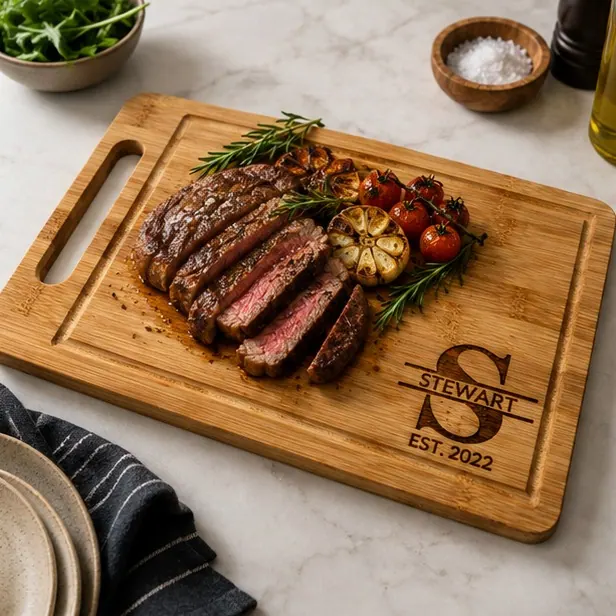
A timeless split layout with your initial, last name and optional EST year.
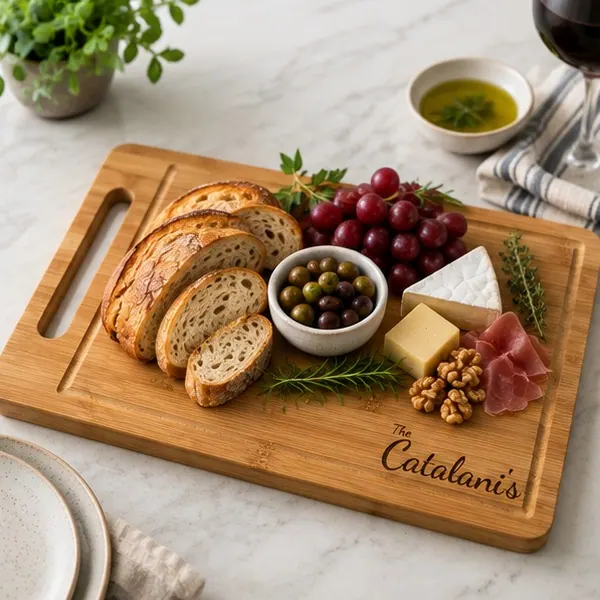
Soft script styling with an heirloom feel, especially strong for wedding gifting.
A butcher block is a thick end-grain or edge-grain surface that mostly stays put. A cutting board is a tool yo
Personalized means something gets made after you order, so it is not a same-day category. Here is the real tim
What to give parents who say they want nothing, how to split one gift between siblings, and what to engrave wh