
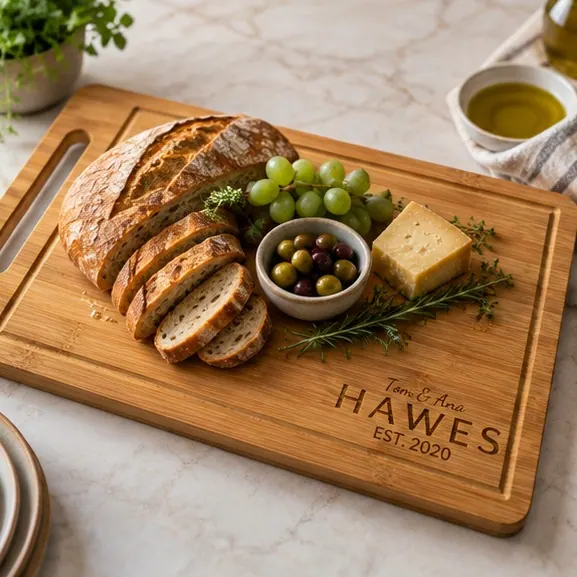
Classic Last Name
First names, last name and an optional EST year in the most versatile layout on the site.
$32.99–$39.99
Home › Guides › Personalized Gifts for New Parents
11 min readThe baby gets forty gifts and the household gets none. What to give the parents instead, when to send it, and what to do about a second baby.
Give the parents something, not the baby. A cutting board is not a baby gift and it would be a strange one: it is not for the child, it will not be used by the child, and nothing about it belongs in a nursery. It is a gift for the household the baby has just arrived into, and that household is the thing nobody is buying for.
That is the entire case, and it is worth being plain about it, because a guide that tries to sell an engraved board as a present for a newborn is selling something silly. What the board is good at is being addressed to the family as a unit at the exact moment the family changed shape.
Count the parcels. Clothes in three sizes, blankets, soft toys, a stack of books, several things that make a noise. Every one of them is correct, most of them are welcome, and nearly all of them are for a person who will have outgrown them before the next birthday.
Meanwhile the two adults who just went through it receive almost nothing, and the house they are running receives less than that.
This is not a criticism of anybody's gift. It is a description of a gap, and the gap is the opportunity. A parcel addressed to the whole family is unusual purely because everything else on the doorstep is addressed to one small person who cannot read.
There is a second reason it works. Baby gifts are consumed by a schedule: outgrown, handed on, donated, forgotten. A household object is on the counter for the years when the child actually starts remembering the kitchen. The gift has a longer life than the occasion that prompted it, which is true of very little else in the pile.
A surname does something different once there is a child in the house.
Before, it was two people who either shared a name or did not, and it was largely paperwork. After, it is the name of a family with members who did not choose it, and most people notice that shift within the first month. Whoever's name the child takes, and whatever the parents decided about their own, the surname is suddenly the name of a group rather than a label on two adults.
That is why an engraved family name lands differently here than at a wedding. At a wedding it marks an event. Here it marks a fact that just became true.
A few practical calls:
Use the surname the child has. That is the household name now, whatever either parent goes by individually. If the parents kept separate names, use the one on the birth paperwork, or use both first names with no surname, which is correct in every arrangement.
Leave the year off, or use a different one. This is the part people get wrong. Engraving the baby's birth year turns a household object into the child's object, and it is the one piece of the family that will eventually have its own house to take things to. If you want a year, use the year the household started: the wedding, the move, whenever the two of them count from. The EST field takes 4 characters and leaving it empty is a perfectly good layout.
Do not engrave the baby's name. It is the obvious idea and it is the wrong one for the same reason. A board carrying one child's name is awkward the moment there is a second, and it is a keepsake for a person rather than a thing for a kitchen.
The classic last-name layout carries both first names above the surname, which reads as a household. The script layout is warmer and sets the possessive for you, so a family called Whitfield comes out as The Whitfield's without you making that call. If the parents are recently married as well, gifts for newlyweds covers confirming a surname that is still new.
The useful sorting question is not what the gift is. It is who it is addressed to and how long it stays relevant.
| Gift | Who it is for | How long it lasts | When to send |
|---|---|---|---|
| Clothes, blankets, toys | The baby | Months | Anytime, and everyone already did |
| A named household object | The family | Years | Two to three months in |
| Delivered meals, groceries | The adults | A week | First two weeks |
| Coffee, good tea, something consumable | The adults | A month | Anytime |
| A cleaning service, a delivery credit | The household | Weeks | First month |
| A photo frame or print | The family | Years | After there are photos worth framing |
| Cash or a contribution | The household | Practical, invisible | Anytime |
Two columns of that table are almost empty in most people's gift lists, and they are the two the parents notice. Pair one useful thing for this week with one lasting thing for the household and you have covered both halves without spending much more than a single larger gift would have cost. What to pair with a board has combinations that work if you want the pairing done for you.
Here is the case almost no gift guide addresses. A first baby gets a shower, a group chat, and a doorstep full of parcels. A second or third frequently gets a card, and sometimes not even that.
The reasoning behind that is usually kind and entirely wrong. People assume the house already has everything, that the family has done this before, and that a gift would be redundant. What actually happens is that the second arrival is harder in every practical sense and is marked by less, which the parents notice even when nobody says so.
A household gift is the right answer here specifically, because it is the one thing that is not a duplicate. They do have the clothes. They do have the equipment. What they do not have is anything recording that the family is now the size it is, and a gift addressed to the household rather than to the newcomer sidesteps the whole redundancy problem.
If the family surname is already on something from the first time, do not send a second identical object. Send something else from the table, or ask. "Did anybody get you anything this time" is an easy question and the answer is frequently no.
Not the first week. The first week is visitors, parcels, and a doorbell that keeps going, and a considered gift arriving into that gets unwrapped in a blur and put on a pile with eleven others. Every parcel in that window competes with every other parcel.
Work down this order instead.
The same logic drives housewarming timing, where arriving a few weeks after the event beats arriving during it for exactly the same reason.
Worth saying, because it decides whether this gift is honest.
Nobody with a newborn is cooking elaborate meals. The kitchen in those first months runs on speed, one hand, and whatever can be eaten standing up. A gift premised on a leisurely dinner is a gift premised on a life the household does not currently have.
So this is a gift for the year after rather than the month after, and that is fine as long as you know it. The board sits on the counter through the period when nobody is cooking, gets used for the fast version of everything, and comes fully into its own when the household starts having people over again, which is usually later than anyone expects.
If you want to be useful now, that is the consumable row of the table, and it is a genuinely good gift. The two are not in competition. One is for this week and one is for the next several years.
On practicality: bamboo at $32.99 is 12in x 7.8in x 0.5in with an integrated handle, which is the easier board to lift and wash one-handed and the one that suits daily use. Acacia at $39.99 is 12in x 8in x 0.6in with a flat unbroken face and visible grain, which reads more like an occasion piece. Both weigh the same packaged. The full comparison covers how each takes the engraving.
An engraved board is $32.99 in bamboo or $39.99 in acacia. With the $6.00 gift box and $8.00 shipping that is $46.99 or $53.99 delivered, and additional boards in the same consignment ship at $4.00 each, which matters if several of you are going in together or if two friends had babies the same season. Sales tax is calculated at checkout from your address.
The gift box carries a card message up to 200 characters, and no packing slip or prices go in the parcel, so it can be sent straight to the house without you handling it. That is worth using here: a household with a new baby is not always up for visitors, and a parcel that arrives complete asks nothing of them.
Production is 3 working days in the Wisconsin workshop, Monday to Friday with a 14:00 CT cutoff, and transit is about 6 days, so a realistic arrival is around 9 days from ordering. There is no deadline on this gift, which is the nice part: you are aiming at a two-month window, not a date.
Before anything is engraved you approve a confirmation showing the exact text as it will be burned, and a board that comes back different from what you approved is remade at no cost. Boards ship unoiled, so the first coat of food-grade mineral oil is the recipient's job, and how to care for a wooden board is the link to put in the card rather than a set of instructions.
Something addressed to the household: a named object for the kitchen, delivered meals, groceries, or a contribution. The baby is already receiving clothes in three sizes from everyone else, and almost nobody is buying for the two adults or the house they are running. A gift to the family as a unit is unusual for that reason alone.
It is a good gift for the household, not for the baby, and it should be given as one. It works because it carries the family name at the point when that name has just become the name of a family rather than a couple, and because it stays on the counter for years rather than being outgrown. It is not useful in the first month, when nobody is cooking properly.
Two to three months after the birth is the best window. The first two weeks are full of parcels and visitors, so anything considered gets opened in a blur, and the quiet stretch afterwards is when a gift actually gets noticed. Later than that is still fine; there is no clock on this one.
Yes, and it is the more thoughtful gift precisely because most people skip it. The assumption that the house already has everything is true of equipment and false of everything else, and a second arrival is marked by far less than the first. Pick something for the household rather than another set of clothes.
The family surname, which is the name the household now goes by. Leave the year off or use the year the household started rather than the birth year, since a birth year turns a kitchen object into the child's keepsake. Do not engrave the baby's name, which becomes awkward the moment there is a second child.
There is no established figure and anyone quoting one is guessing. What matters more is the split: something small and consumable in the first fortnight, and something lasting for the household a couple of months later. Our own boards are $32.99 and $39.99, or $46.99 and $53.99 once boxed and shipped, which sits comfortably at the considered-gift end without being an event.
You can, as long as it carries the family surname rather than anything about the child, since nothing about the household name depends on the birth. Sending it early also avoids the crowded fortnight afterwards. Avoid engraving a name or a date you do not have yet, because the personalization cannot be changed once the board goes on the laser.
See the three layouts in both woods with a live preview, so you can type the surname and see how it sits before anything is made. If the household is also new, personalized housewarming gifts covers the move, and Christmas gifts for families handles the version where one gift has to work for everyone in the house.
First names, last name and an optional EST year in the most versatile layout on the site.
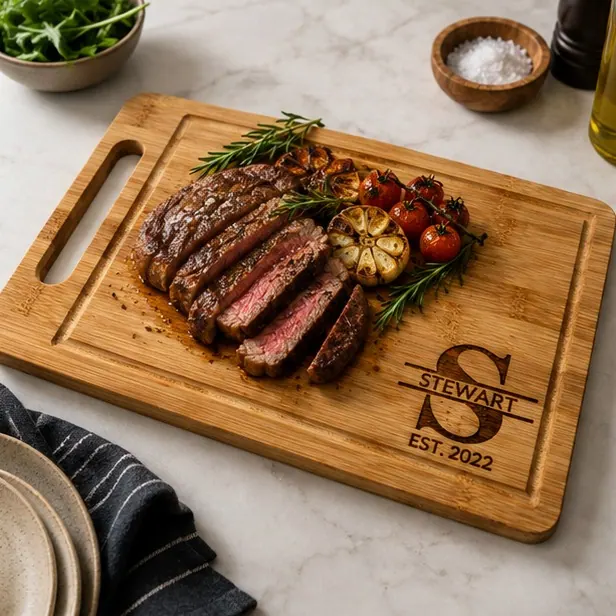
A timeless split layout with your initial, last name and optional EST year.
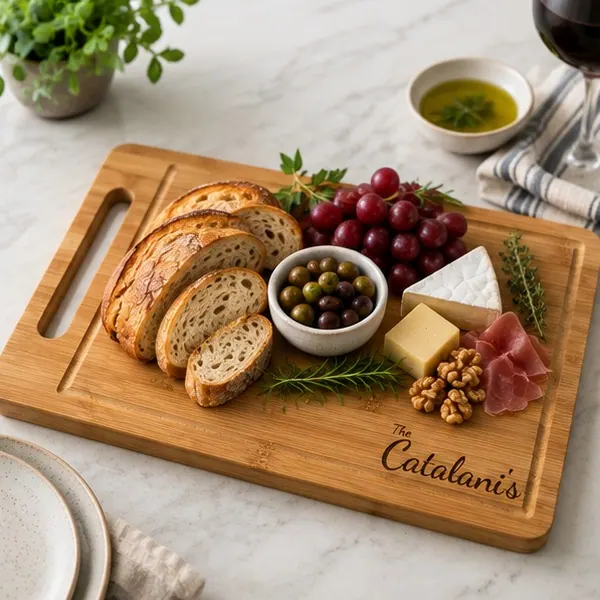
Soft script styling with an heirloom feel, especially strong for wedding gifting.
A butcher block is a thick end-grain or edge-grain surface that mostly stays put. A cutting board is a tool yo
Personalized means something gets made after you order, so it is not a same-day category. Here is the real tim
What to give parents who say they want nothing, how to split one gift between siblings, and what to engrave wh