
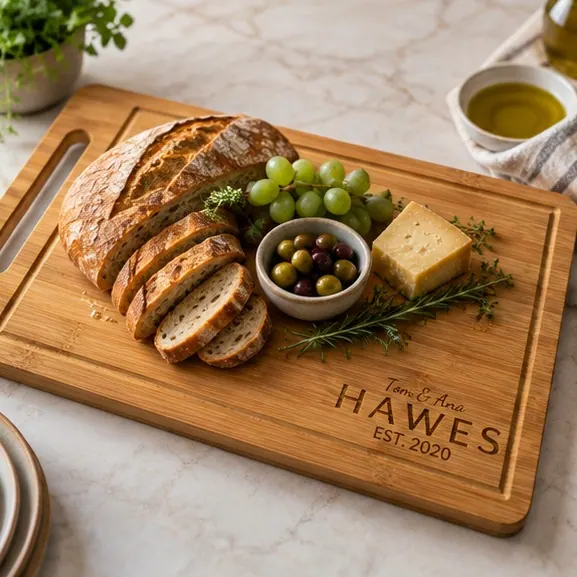
Classic Last Name
First names, last name and an optional EST year in the most versatile layout on the site.
$32.99–$39.99
Home › Guides › Personalized Gifts for Someone Who Has Everything
9 min readThey do not own everything. They can just buy anything, which leaves four categories of gift, and only one of them costs under $50 and gets kept.
Someone who has everything is not short of objects. They are short of objects they could not have bought themselves, which is a different problem with a much narrower solution. Anything you find in a store they can find in the same store, usually in a better version, usually next week if they feel like it. Shopping harder does not close that gap, because shopping is the thing they are already better at than you.
What closes it is picking a category where purchasing power is irrelevant. There are four, and they are the whole of this guide.
Run the test on anything you are considering: could the recipient have bought this for themselves, today, without thinking about the price?
If yes, you are not giving them something new. You are giving them a copy of a decision they already declined to make, or an object they own in some form already. That is why the good-taste route fails so reliably here: a beautiful, well-chosen, expensive thing is exactly what they buy for themselves on a Tuesday.
If no, the gift has a reason to exist, and there are only a handful of ways for the answer to be no.
| Category | Why they cannot buy it | What works | What fails |
|---|---|---|---|
| Their own name on something | Ordering an object engraved with your own surname is not something people do for themselves | A board reading THE WHITFIELDS, a family name in script, a split monogram | Initials on a luxury item they already own a version of; a monogram in a font that dates |
| Their own events, marked | They will not commission a record of their own wedding, move or anniversary | A surname with EST and the year; a date engraved on something used weekly | A guessed date; an event that has not happened yet |
| Consumables | Not that they cannot buy them, but they get used up, so there is no duplication and no storage problem | Good olive oil, a coffee subscription, something from a region they love | Another candle; anything they have to find a cupboard for |
| Experiences | Requires someone else to organize it, which is the part they will not do | A booked dinner, a class, tickets with a date already chosen | An open-ended voucher that becomes homework; anything needing their calendar to be solved first |
Notice what those four have in common. None of them can be improved by spending more, and three of them are cheap. The constraint on this gift was never budget.
Consumables run out, experiences need scheduling, and events come along only occasionally. Names are available all the time, and the gap never closes: however much someone owns, they do not own a thing with their own name on it, because buying that for yourself is a slightly odd act and everybody knows it.
This is why a modest personalized object outperforms an expensive generic one with this recipient specifically. A $32.99 bamboo board or a $39.99 acacia one engraved with a household surname is not competing with anything they own, because nothing in the house resembles it. It is the only object in the kitchen that could not be replaced by ordering another one.
A few things make the difference between a named object that gets kept and one that gets put away:
For the full set of options on what actually goes on the object, the engraving ideas guide is the one to read before you order, and monogram versus last name settles the layout question in about a minute.
The second category is the same trick pointed at a date rather than a name. Someone who has everything still has a year they bought the house, a year they married, a year the business opened. Nobody records those for themselves.
Which is why this works best at exactly the occasions where the recipient is hardest to buy for. A retirement, a fortieth anniversary, a house they waited a decade for: in each case the thing they do not have is an object that says when. The gift is not the board, it is the date.
Two rules. Use the year rather than the full date unless the day itself is the point, because a year ages correctly and a full date starts to look like a certificate. And confirm the year with someone before ordering, because this is the one detail where being approximately right is worse than leaving it off.
Consumables are underrated and slightly thin. Their advantage is structural: nothing has to be stored, nothing duplicates anything, and a person with a full house loses nothing by receiving something that disappears. Their weakness is that they leave nothing behind, so they read as generous rather than as considered. They are the best thing to pair with a named object and a weak choice as the entire gift.
Experiences work only when the organizing is already done. The reason someone who has everything does not book the thing is not money, it is calendar friction. A gift that hands them an open voucher and a booking website has handed them a task. A gift with a date, a time and a reservation already made has removed one. If you cannot do the second version, do not do the first.
The instinct with a well-supplied recipient is to buy a better version of something they already have. A nicer knife, a heavier pan, a premium version of an everyday object. It fails more often than anything else on this page, for three reasons.
It invites a comparison you will lose. Your gift arrives into a house where the incumbent object is already in use and already liked. It gets held next to it and judged against it, on terms set by someone who knows more about that category than you do.
Preferences in these categories are specific and invisible. Handle shape, weight, how a pan sits on their stovetop. Someone who has everything has those preferences precisely because they have tried things, and you are guessing at the output of years of trying.
It costs several times more and lands lower. A serious upgrade to a kitchen item runs well past $150, and the realistic best outcome is that it quietly replaces something. A $39.99 named board has no incumbent to displace and nothing to be compared against. Spending more buys a better object in a category where they are already well supplied, which is the one category that does not need help.
Because the limit is not what they own, it is what they can buy. Anything available to you is available to them, usually in a better version, so ordinary shopping cannot produce something they do not already have access to. The gift has to come from a category their own money does not reach: their name on something, their own events marked, something that gets consumed, or something someone else organized.
An object carrying their own name or a date from their own life. Nobody orders a thing engraved with their own surname, so that gap stays open regardless of income. A board reading their family name with the year they married or moved costs $32.99 to $39.99 and cannot be duplicated by anyone, including them.
No, and it usually hurts. A more expensive version of something they own gets compared to the one already in use, judged by someone who knows that category better than you, and often loses. Money buys quality in categories where they are already well supplied, which is the one place the gift does not need help.
Yes, with one limit. Consumables never duplicate anything and never need to be stored, which solves the practical half of the problem, but they leave nothing behind so they read as generous rather than considered. Use one alongside something personalized rather than as the whole gift.
Only when the booking is already made. The obstacle is calendar friction, not cost, so an open voucher and a booking link is a task rather than a present. A specific date, time and reservation removes work and is a genuinely good gift for this recipient.
A premium version of something they already own, another candle or decorative object that needs shelf space, and anything open-ended that requires them to organize it. Also avoid personalizing details that change, such as an address or a job title, because those expire while a name and a year do not.
No. Price is the axis they have already solved, so competing on it is competing where you cannot win. A $39.99 engraved object that records their name and their year is doing something that a $400 generic one structurally cannot, which is being impossible for them to have bought.
If the recipient cooks or entertains at all, a named kitchen piece is the shortest route into the one category that stays open. All three layouts come in bamboo at $32.99 and acacia at $39.99, each with a live preview of your text before you order, and the acacia last name board is the version that looks most like an object someone chose deliberately. If it is a whole family rather than one person, personalized Christmas gifts for families covers how the household name does the work of several separate gifts.
First names, last name and an optional EST year in the most versatile layout on the site.
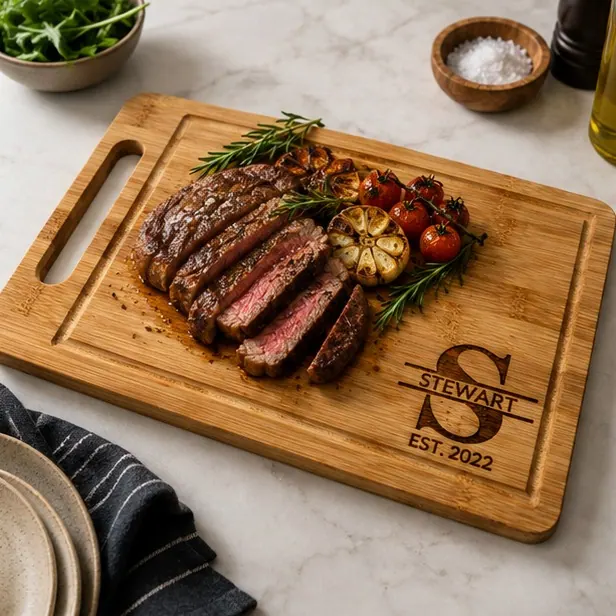
A timeless split layout with your initial, last name and optional EST year.
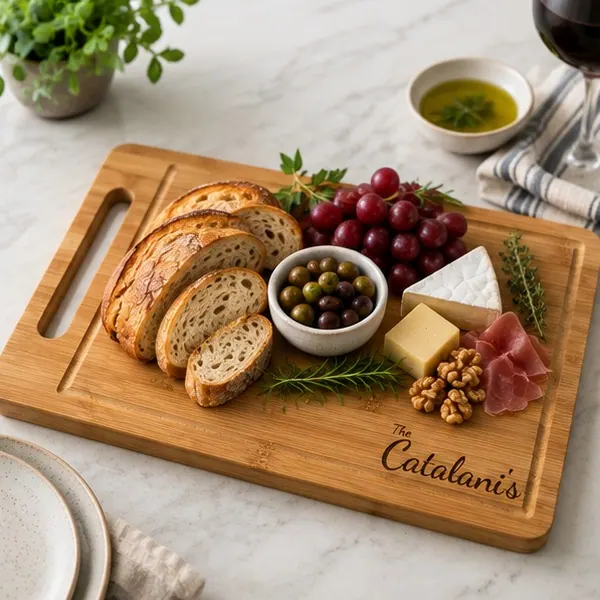
Soft script styling with an heirloom feel, especially strong for wedding gifting.
A butcher block is a thick end-grain or edge-grain surface that mostly stays put. A cutting board is a tool yo
Personalized means something gets made after you order, so it is not a same-day category. Here is the real tim
What to give parents who say they want nothing, how to split one gift between siblings, and what to engrave wh