
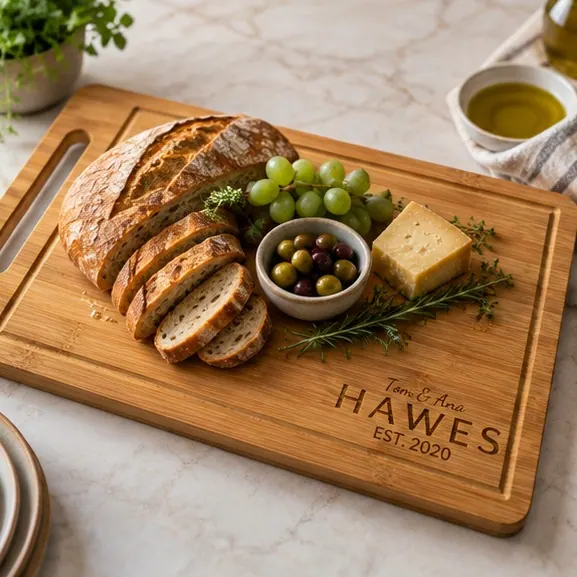
Classic Last Name
First names, last name and an optional EST year in the most versatile layout on the site.
$32.99–$39.99
Home › Guides › Personalized Gifts for Couples Moving In Together
12 min readA first shared home with no wedding and often no shared surname. What to engrave instead, why a year can be the wrong call, and when to give nothing.
Engrave both first names and leave the surname out. That one decision solves most of what makes this gift awkward, because a couple moving in together often has no shared name, no wedding, no agreed anniversary, and no formal moment that anybody sends cards for. The milestone is real. The vocabulary for marking it is not.
So the gift has to do something slightly unusual: acknowledge a significant step without claiming it is a different step than it is.
Both of those have a script. This does not, which is why generic advice fits it badly.
A housewarming is about the building. Somebody moved, and the gift is addressed to a new address. It can be given to one person or a family, it carries no assumption about anyone's relationship, and the guides for it are about doors, cabinets and wall holes. Housewarming gifts for renters and apartments covers that version properly, including what fits in a small kitchen, and it is the right guide if the couple is renting and the emphasis really is on the flat.
A wedding gift is about a legal and social event with a date, a guest list and a name change. Everything in that category assumes a surname and an anniversary exist. Wedding gifts for couples who already live together is the guide for the couple who does this in the other order, and it is worth reading if the move-in is a prelude to a wedding you already know about.
Moving in together sits between them and borrows from both. It is a relationship milestone that produces a household, and the gift that works is one addressed to the household while staying quiet about the relationship's future. That is a narrower target than either neighbor, and it is why the surname question gets hard.
For a married couple, the surname is a fact you look up. Here it is a question with several possible answers and one of them is not yet decided by the people involved. The general version of that problem, and why both first names is the safe default for any unmarried couple, is worked through in Christmas gifts for couples.
What the move adds is a second layer. This is the moment the couple is most likely to be asked where things are going, by parents, by colleagues and by each other, and a gift arriving in the same month with a shared surname on it joins that conversation uninvited. The answer is still first names, but the stakes are higher here than they are in December.
| Situation | What to engrave | Layout | Why it works |
|---|---|---|---|
| Two surnames, both keeping them | Both first names, no surname | Script or classic last name | Names the household without naming a merger |
| Engaged, name already decided | The agreed surname, no year | Classic or split monogram | They have said it out loud, so you can too |
| Engaged, name not discussed | Both first names | Classic last name | Avoids answering a question they have not |
| Together a long time, no plans to marry | Both first names, plus the move-in year | Script | The move is a real date they both agree on |
| Very new relationship | No names, or no engraving at all | Plain board, or a non-personalized gift | A permanent object is louder than the step |
| Your own partner, moving in with you | Both first names and the year you moved in | Script or classic | You are inside the relationship, so you know what is safe |
| You barely know one of them | Nothing engraved | Consumable, card | The gift should not know more than you do |
The fields that matter: first names take 40 characters, which comfortably fits two long names and an ampersand, surname takes 24, and EST takes 4, which is a year and nothing else.
One structural note on layouts. The split monogram is built around a single shared initial, so it cannot represent two surnames at all, which rules it out for most couples in this situation. The script layout sets the name possessively and engraves the apostrophe automatically, so it produces The Whitfield's, which means it is a surname layout by design and is the warmest option when a surname is genuinely appropriate. The classic last name layout carries both first names above a surname line, and it is the one that works with the surname line simply left as the couple's shared home rather than a name. Monogram versus last name covers the trade-offs between them in more detail.
The instinct is to add a date. Resist it until you know which date you mean.
A wedding has one unambiguous year. A relationship frequently has three: the year they met, the year one of them would call the start, and the year the other one would. Couples disagree about this cheerfully and often, and a permanent object that picks a side is a small joke that stops being funny.
The move, on the other hand, is a date with a lease or a closing attached to it. Both of them know it and neither of them disputes it. If you want a year, use that one, and if there is any doubt, leave the EST field empty. An engraved board with two first names and no date is complete as it is, and it never becomes wrong.
Worth being direct about this, because it is the real failure mode and nobody names it.
An engraved object is a statement of permanence. That is exactly its appeal for a wedding, and it is exactly the risk here. A gift that assumes a future the couple has not discussed puts them in the position of thanking you for it.
Run this order before you order anything personalized.
The practical half of this. When two people combine homes, the result is two of everything cheap and none of anything good: two cheese graters, four spatulas, two sets of mismatched plates, and no decent knife between them.
So the useful gift is not an addition. It is an upgrade to one thing they use constantly and own a tired version of, or something that is not a duplicate by its nature.
Things that are almost always duplicated: mugs, glassware, mixing bowls, basic utensils, small appliances. Adding to these makes the merge harder rather than easier, because both of them are currently trying to decide which set goes to the charity shop.
Things that are almost never duplicated: anything carrying both their names. Nothing either of them brought from a previous apartment says these two people on it, and that is the structural reason a named object works here even though the cupboards are full. It also means it does not participate in the cull, which is the process every merged household goes through in the first three months.
Things that get used up: wine, coffee, a delivery credit, a meal out. The safest gift in the entire category, and the right one if you are at all unsure of your footing.
If the couple is also equipping a kitchen from scratch, the best personalized kitchen gifts covers what earns its counter space, and what size board you need is worth a look if the new place has a small kitchen, since a first shared apartment often does.
Often, no. That is a legitimate answer and it is under-represented in gift guides for obvious reasons.
Moving in together is not an occasion that generates invitations. If you found out in passing, a message saying congratulations is proportionate and a parcel might not be. The test is whether you would be invited to the flat in the first month. If yes, something small is welcome. If no, a card is the whole correct gift.
If they are having people over, you are in housewarming territory and the normal rules apply: something for the house, something consumable, or both. What to bring to a housewarming party covers that, and what to write in the card covers the wording, which in this situation is doing more work than usual.
If you are a parent or a sibling, you have more latitude than a friend does, and a household gift with both first names is a warm thing to send. Family is allowed to treat this as a milestone even when the couple is being casual about it.
If it is your own partner, none of the caution above applies to you. You know what the two of you have said. Both first names and the year you moved in is a good record of a date that will otherwise go unmarked, and it is one of the few gifts that acknowledges a step nobody else sends anything for.
Bamboo is $32.99 at 12in x 7.8in x 0.5in with an integrated handle, which suits a small kitchen and daily use. Acacia is $39.99 at 12in x 8in x 0.6in with a flat unbroken face and visible grain movement. Both weigh the same packaged, so choose on thickness and grain rather than heft, and the wood comparison has how each takes the engraving.
With the $6.00 gift box and $8.00 shipping that is $46.99 or $53.99 delivered, and additional boards in the same consignment ship at $4.00 each. The card message takes 200 characters, and no packing slip or prices go in the parcel, so it can go straight to the new address without you handling it. Sales tax is worked out at checkout from your address.
Production is 3 working days in the Wisconsin workshop, Monday to Friday with a 14:00 CT cutoff, and transit is about 6 days, so a realistic arrival is roughly 9 days. Moves slip, so send it to the new address a couple of weeks after they are actually in rather than aiming at the moving day itself, when the hallway is full of boxes and nothing gets opened.
You approve a confirmation showing the exact engraving text before anything is burned, which is the moment to reread the names, and a board that comes back different from what you approved is remade at no cost. Boards ship unoiled, so the first coat of food-grade mineral oil is the new household's job.
Only if you are close enough to be in the flat in the first month, or if they are marking it with a gathering. It is not an occasion that generates invitations, so a message of congratulations is a complete and proportionate response from most people. Family and close friends have more latitude and can treat it as the milestone it is.
No. A housewarming is addressed to an address and says nothing about anyone's relationship, while this gift acknowledges a couple taking a step together. The practical difference is the personalization: a housewarming gift can carry a surname safely, and this one usually should not.
Give something lighter now and save the engraved, named gift for the wedding, where a shared surname and a date are the whole point. Two permanent keepsakes inside a year is one too many, and the second one always looks like the afterthought. A consumable or an upgrade covers the move perfectly well.
Both first names, in almost every case. The first-names field takes 40 characters, which fits two long names with room to spare, and it names the household without making a claim about a name change nobody has announced. Save the surname version for an engagement or a wedding, where it is the whole point.
The year they moved in, or no year at all. Relationship start dates are frequently disputed between the two people involved, so a board that picks one is a permanent guess, while the move is a date with a lease attached that both of them agree on. Leaving the four-character EST field empty is a complete layout, not an omission.
Either an upgrade to something they both own a worn-out version of, or something that cannot be a duplicate. Merged households end up with two of everything cheap and none of anything good, so a single excellent knife, pan or board is more welcome than another set of mugs. An object carrying both their names is the one thing neither of them already brought.
Name the step without inflating it: something about the new place, the two of them in it, and an offer to visit once the boxes are gone. The card is where warmth belongs, which is exactly why the engraving can stay understated. Two hundred characters is enough for three good sentences.
See the three layouts in both woods with a live preview, so you can type both first names and see how they sit before anything is made. If a wedding is on the horizon, what to engrave on a wedding board covers the version with a surname and a date, and engagement gifts covers the step in between.
First names, last name and an optional EST year in the most versatile layout on the site.
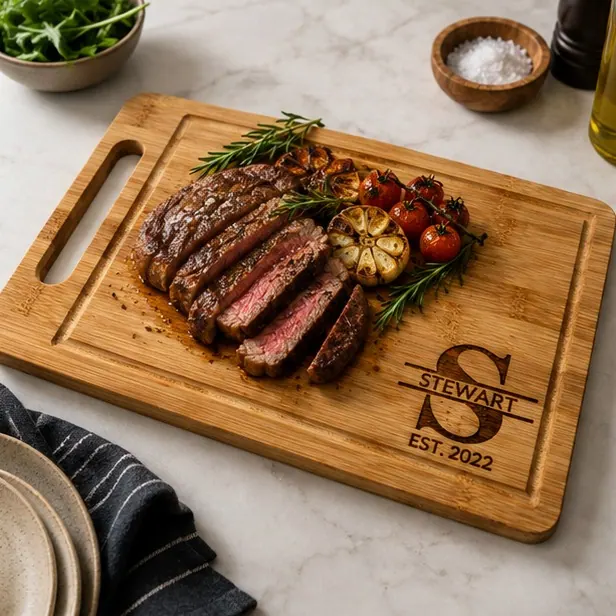
A timeless split layout with your initial, last name and optional EST year.
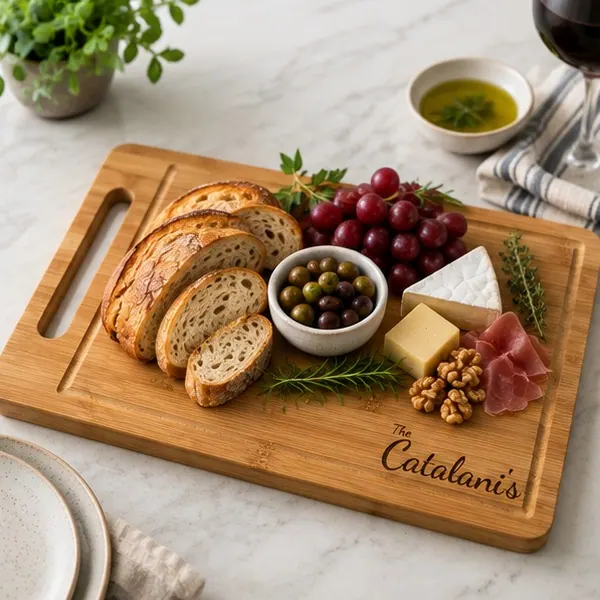
Soft script styling with an heirloom feel, especially strong for wedding gifting.
A butcher block is a thick end-grain or edge-grain surface that mostly stays put. A cutting board is a tool yo
Personalized means something gets made after you order, so it is not a same-day category. Here is the real tim
What to give parents who say they want nothing, how to split one gift between siblings, and what to engrave wh